
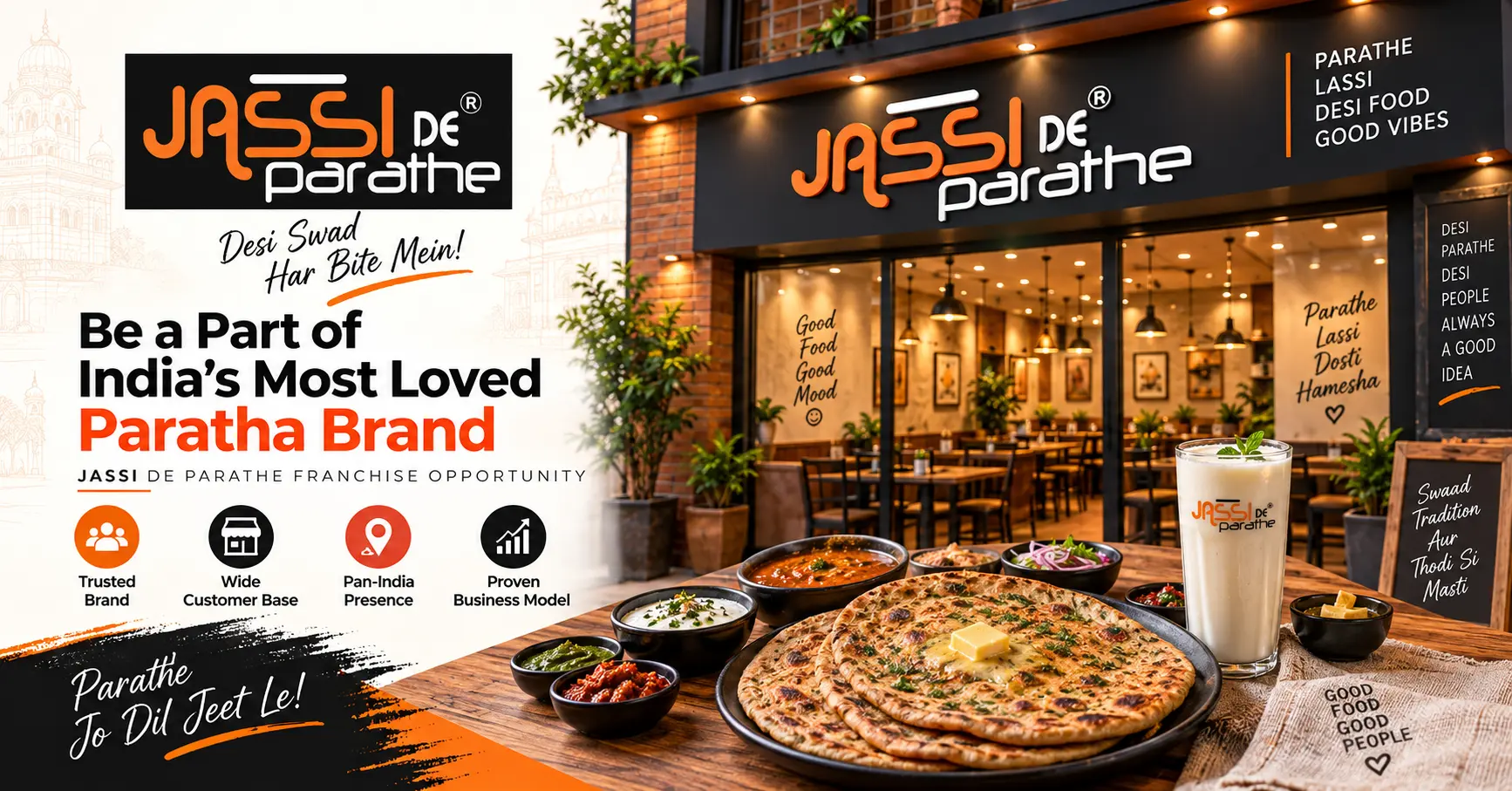
A Jassi De Parathe franchise sounds like the kind of opportunity that can immediately attract a food entrepreneur.
The brand started from a humble food-cart story, built its identity around authentic Punjabi food and now operates restaurants across Ahmedabad, Gandhinagar, Vadodara, Anand and Surat. Its official history dates the Jassi De Parathe concept to 2003, when it began from a pushcart near Mansi in Ahmedabad before growing into permanent restaurants.
But prospective franchisees need to know something before searching for the investment, royalty or profit margin.
Jassi De Parathe’s official franchise page currently says franchise applications for India are not being accepted.
The website explicitly tells India applicants to check back later.
That makes this opportunity different from most restaurant franchises.
The most useful question right now isn’t:
“How much does a Jassi De Parathe franchise cost?”
It is:
“What should I understand and prepare before the brand begins accepting Indian franchise applications again?”
Because while the company does not currently publish its franchise investment or royalty, its detailed application form reveals quite a lot about what it expects from a potential partner.
First: Can You Currently Apply for a Jassi De Parathe Franchise in India?
At present, no—not through the normal official India franchise application route.
Jassi De Parathe’s current franchise page displays the message:
“Franchise applications for India are not being accepted at this time. Please check back later.”
This is the single most important current fact for Indian investors.
The brand still maintains an extensive franchise application form, including fields relating to personal information, financial background, hospitality experience, property and proposed outlet details. But the India application route is currently paused.
That means applicants should be particularly cautious about third-party websites or agents claiming they can guarantee immediate Jassi De Parathe franchise approval in India.
If the official website says applications are paused, any contradictory offer deserves careful verification directly with the brand.
Jassi De Parathe Started as a Pushcart in Ahmedabad
The brand’s growth story helps explain why the franchise generates interest.
Jassi De Parathe says it has been serving authentic Punjabi recipes from Punjab to Gujarat since 2003. The business began with a pushcart near Mansi in Ahmedabad before eventually developing into permanent restaurants.
The company’s detailed history credits Jasvirsingh Dhaliwal and his family—particularly Jasvinder Kaur—with building the concept around authentic family recipes and customized masalas.
According to the official account, the first permanent outlet was established near Vastrapur Lake in Ahmedabad, followed by further locations in areas such as Prahlad Nagar and Odhav.
Today, the official locations directory lists restaurants in:
- Vastrapur
- Prahlad Nagar
- Odhav
- Gandhinagar
- Alkapuri, Vadodara
- Anand
- Vaishnodevi
- Surat
This is still a relatively focused network compared with mass-market QSR chains—which may be part of the attraction for entrepreneurs looking for a more differentiated regional restaurant brand.
Jassi De Parathe Franchise Cost: The Official Site Doesn’t Publish It
This is where prospective investors need to be careful.
Jassi De Parathe’s current official franchise page does not publicly state:
- Total investment
- Franchise fee
- Royalty
- Marketing contribution
- Minimum capital
- Minimum store size
- Expected turnover
- Profit margin
- Payback period
That means there is currently no reliable official public figure that should be presented as the Jassi De Parathe franchise cost.
You may find numbers quoted on blogs and franchise directories.
Treat them carefully.
Restaurant investments can vary enormously according to:
- Property size
- City
- Rental deposit
- Restaurant format
- Kitchen equipment
- Interiors
- Seating capacity
- Franchise fees
- Working capital
And with Jassi De Parathe currently not accepting India applications through its official page, there is even less reason to assume an old or third-party quote represents present commercial terms.
Don’t Base Your Budget on an Unverified Online Figure
Suppose a website tells you that a Jassi De Parathe franchise requires ₹50 lakh.
Another source may claim ₹1 crore.
Another may quote substantially more.
Without an official current proposal, none should automatically become the basis of your business plan.
The correct sequence is:
1. Wait for or confirm current franchise availability.
2. Get the latest official commercial proposal.
3. Confirm the required restaurant format and property size.
4. Calculate the total capital requirement.
5. Only then evaluate expected returns.
This is particularly important with full-service restaurants because a franchise fee can represent only a small part of the actual project cost.
What the Franchise Application Reveals About Jassi De Parathe’s Selection Process
Although applications are currently paused for India, the official form gives prospective investors useful insight into what the company examines.
Jassi De Parathe asks applicants about:
Professional background
The application requests current occupation, organisation, industry, total work experience and entrepreneurial experience.
Financial background
Applicants are asked about their source of funds and other financial details.
Hospitality experience
The form asks whether applicants have prior F&B or hospitality experience.
It also asks whether they have previously operated a franchise.
Management capability
Applicants are asked whether they have experience managing teams or serving customers.
Property availability
The brand asks whether the applicant already owns or leases a suitable property.
If so, the address and size are requested.
Expected outlet size
The application specifically asks applicants to enter the expected outlet size in square feet.
That tells us something important.
Jassi De Parathe appears to evaluate more than whether an applicant simply has enough money.
Capital Alone May Not Be Enough
Many franchise applicants focus almost entirely on the investment.
But Jassi De Parathe’s form suggests the company also wants to understand:
- Business experience
- Entrepreneurial experience
- Hospitality exposure
- Franchise experience
- Team-management capability
- Funding source
- Property readiness
- Familiarity with the brand
The application even asks whether the potential franchisee has dined at Jassi De Parathe before.
That is a useful signal.
The company may be looking for partners who understand the actual restaurant experience rather than investors choosing the brand solely from a franchise directory.
Visit the Restaurant Before Thinking About the Franchise
This is good practice for any restaurant franchise, but it is particularly relevant here because Jassi De Parathe explicitly asks whether franchise candidates have eaten at the brand.
Visit more than one outlet if possible.
Observe:
- Customer traffic
- Average group size
- Table turnover
- Menu pricing
- Staff count
- Kitchen activity
- Restaurant size
- Takeaway demand
- Delivery pickups
- Weekend traffic
- Lunch versus dinner demand
Don’t visit only during the busiest Saturday evening period.
A franchise has to cover its fixed costs on Tuesday afternoons too.
Jassi De Parathe Is Bigger Than Just Parathas
The brand’s name naturally suggests a paratha-focused restaurant.
Its actual offering is broader.
Jassi De Parathe positions itself around authentic Punjabi and North Indian dining, while its related Punjabiyat concept emphasizes traditional Punjabi dishes cooked using traditional techniques and spices. Signature dishes highlighted by the brand include preparations such as dal makhani, tandoori paneer, biryani and naan-based meals.
The company also operates a Tray Menu catering service designed for parties and small gatherings, with the brand saying its crew can provide a full catering setup and handle waste disposal.
For a franchisee, the potential existence of dine-in, takeaway, delivery and catering channels can be commercially important.
But applicants should verify which revenue streams are included in their particular franchise agreement.
Why Menu Complexity Matters to Profit
A full-service Punjabi restaurant has completely different economics from a small tea kiosk or packaged-food outlet.
It can require:
- Larger kitchen
- Tandoor setup
- Refrigeration
- Multiple preparation stations
- Skilled cooks
- Service staff
- Cleaning staff
- Larger seating area
- More inventory
- Higher utilities
That means the investment isn’t the only number to investigate.
You also need to understand the restaurant’s monthly operating structure.
The simplified formula is:
Sales – Food Cost – Salaries – Rent – Royalty – Utilities – Delivery Costs – Marketing – Maintenance = Operating Profit
Every term matters.
Restaurant Revenue Can Look Impressive While Profit Remains Modest
Imagine a Jassi De Parathe restaurant eventually generates ₹30 lakh in monthly sales.
That sounds impressive.
But suppose monthly expenses include:
- ₹9 lakh food cost
- ₹5 lakh staff cost
- ₹3 lakh rent
- ₹1.5 lakh utilities
- Franchise-related charges
- Delivery commissions
- Maintenance
- Local marketing
- Miscellaneous expenses
The owner’s income is not ₹30 lakh.
It is whatever remains after all the costs are paid.
That is why prospective franchise owners should never evaluate a restaurant based only on turnover.
The Brand Doesn’t Publish a Franchise Profit Margin
Jassi De Parathe’s current franchise page does not publish a guaranteed:
- Gross margin
- EBITDA
- Net profit
- Monthly owner income
- ROI
- Payback period
That is not unusual.
Restaurant profitability is highly dependent on the individual outlet.
But it does mean that claims online such as:
“Earn X lakh every month”
or
“Recover your investment in 18 months”
should not be attributed to Jassi De Parathe unless the company provides those projections directly.
If ROI Is Offered Later, Ask How It Was Calculated
When Indian applications reopen, the company may provide applicants with projected restaurant economics.
If so, don’t focus only on the ROI percentage.
Ask for the assumptions.
For example:
Projected monthly sales: How were these estimated?
Food cost: What percentage of revenue?
Staff cost: How many people?
Rent assumption: Does it match your proposed city?
Royalty: Included or excluded?
Marketing fee: Included or excluded?
Delivery commissions: Included?
Working capital: Included in total investment?
Rental deposit: Included?
Only after answering those questions can you meaningfully evaluate the projected return.
Property Selection Could Be One of the Biggest Decisions
The official application asks whether the candidate already has a suitable property and requests its address and size. It separately asks for expected outlet size.
That makes site selection an obvious part of the franchise discussion.
Jassi De Parathe’s existing network also demonstrates that restaurants can operate in different commercial environments.
The official locations page includes stores around Vastrapur Lake, Prahlad Nagar, Odhav, Gandhinagar, central Vadodara, Anand, Vaishnodevi and Vesu in Surat.
Before signing a property, applicants should eventually get the brand to approve:
- Carpet area
- Frontage
- Floor
- Parking
- Kitchen ventilation
- Exhaust
- Gas requirements
- Electrical load
- Water availability
- Signage
- Seating
- Delivery access
Don’t Sign a Lease Simply to Look “Franchise Ready”
This deserves emphasis because the official application asks whether a potential franchisee already owns or leases a property.
Having a site may strengthen an application.
But taking a costly long-term lease before the franchisor approves the property can create unnecessary risk.
This is especially true right now because the official site says India franchise applications are paused.
Paying rent on a location while waiting for an uncertain franchise opportunity makes little financial sense.
If you are preparing for a future application, identify potential properties.
Don’t necessarily lock yourself into one.
Jassi De Parathe’s Existing Locations Give Investors Another Clue
The official directory currently lists eight locations spanning Ahmedabad and other major Gujarat cities.
Several of these stores occupy upper-floor commercial properties rather than only traditional street-level restaurant sites.
For example, the Prahlad Nagar location is listed above a McDonald’s, the Vaishnodevi location is on the second floor, and the Surat restaurant is listed on the first floor of a commercial complex.
That suggests ground-floor frontage may not always be an absolute requirement.
However, applicants should not assume the same rule applies to future franchise sites.
Location approval should come directly from the franchisor.
Brand Authenticity Could Be One of the Franchise’s Main Selling Points
Jassi De Parathe’s official story repeatedly emphasizes family recipes, customized masalas and Punjabi home-style food.
The company says Jasvinder Kaur supervised spice selection and preparation and that customized masalas are central to the paratha recipes.
For a franchise system, that presents both an advantage and an operational challenge.
The advantage is differentiation.
A restaurant built around recognizable recipes and brand-specific taste can stand apart from generic North Indian restaurants.
The challenge is maintaining that same flavour across different outlets.
Prospective franchisees should therefore ask exactly how recipes and ingredients are standardized.
Supply Chain Questions You Should Eventually Ask
When India applications resume, ask:
- Which masalas come directly from Jassi De Parathe?
- Which ingredients can be sourced locally?
- Are approved vendors mandatory?
- Are minimum purchase quantities imposed?
- How frequently are supplies delivered?
- Who pays freight?
- How are purchase prices revised?
- Who bears wastage?
- Are recipes or premixes supplied centrally?
- Are menu prices controlled by the franchisor?
These answers can materially influence food cost and therefore profitability.
Staffing Could Be a Bigger Expense Than Applicants Expect
A restaurant serving a broad Punjabi menu requires more manpower than a compact quick-service outlet.
Potential roles can include:
- Restaurant manager
- Cashier
- Captains
- Servers
- Tandoor chef
- Curry chefs
- Prep staff
- Cleaning staff
- Dishwashing staff
- Delivery/packing team
The staffing requirement will depend on restaurant size and sales volume.
Before investing, ask Jassi De Parathe for a sample staffing structure for a typical outlet.
Then use current salaries in your city, not salaries from another location, when calculating profitability.
What About Catering?
Jassi De Parathe’s Tray Menu service provides food for parties and small gatherings and describes a model where its crew can provide setup and manage waste disposal.
That creates an interesting question for franchise applicants:
Can franchisees participate in catering revenue?
If yes, ask:
- Is the catering territory exclusive?
- Does the local outlet prepare the food?
- Who gets the revenue?
- Are separate royalties charged?
- Who handles staffing?
- What minimum order applies?
Additional sales channels can improve restaurant economics, but only if the franchise agreement allows the franchisee to benefit from them.
What Should a Prospective Franchisee Do While Applications Are Paused?
The current pause doesn’t mean you can’t prepare.
Use the time to do the work many applicants skip.
Study the existing outlets
Visit several Jassi De Parathe restaurants and understand how the business operates.
Study your city
Identify neighbourhoods where authentic Punjabi family dining has strong demand.
Estimate property economics
Research rent for restaurant-compatible properties.
Build a realistic budget
Include property deposit, fit-out, equipment and working capital rather than guessing only the franchise fee.
Preserve liquidity
Don’t spend your entire available capital preparing for an opportunity that isn’t currently open.
Contact the company directly
If you want to confirm whether franchise availability has changed, use the official contact channels rather than relying on intermediaries.
How to Contact Jassi De Parathe
The current official franchise page lists:
Phone: +91 95102 22000
Email: info@jassideparathe.com
Address:
28, Sardar Centre,
Opp. Vastrapur Lake,
Vastrapur, Ahmedabad – 380015,
Gujarat, India.
The same contact information is also displayed on the company’s official Contact page.
Because Indian franchise applications are currently paused, contacting the brand directly is the best way to determine whether the status has changed before paying any third party.
20 Questions to Ask When India Franchise Applications Reopen
The current form tells us what Jassi De Parathe wants to know about applicants.
Applicants should be equally detailed about what they need from the company.
Ask:
- What is the current total franchise investment?
- What is the upfront franchise fee?
- Is GST additional?
- What royalty applies?
- Is there a marketing fee?
- What minimum restaurant area is required?
- What seating capacity is recommended?
- What frontage or floor requirements apply?
- How much does a standard fit-out cost?
- What kitchen equipment is required?
- Is the rental deposit outside the project estimate?
- How much working capital is recommended?
- What is the benchmark food-cost percentage?
- How many employees are normally required?
- Which ingredients must be purchased centrally?
- What training does Jassi De Parathe provide?
- Does the franchise include catering rights?
- What is the agreement duration?
- What renewal and transfer fees apply?
- Does the franchisee receive territorial protection?
And if the company shares revenue examples, ask:
“Are these average outlet results, selected successful restaurants or projections for my proposed site?”
Is a Jassi De Parathe Franchise Worth Considering?
For someone interested in Punjabi casual or family dining, there are clear reasons to watch the opportunity.
Jassi De Parathe has been serving customers since 2003, has expanded beyond Ahmedabad into several Gujarat cities and has developed an identity around authentic Punjabi recipes and family-supervised food traditions.
Its current application also indicates that the company approaches franchise selection seriously, examining applicants’ finances, experience, management background and proposed property.
But right now, the key limitation is straightforward:
Indian franchise applications are paused.
And because the public website does not publish the investment, royalty or expected profitability, there is no sound basis for declaring a precise current franchise cost.
That information should come directly from Jassi De Parathe when franchise opportunities become available again.
Frequently Asked Questions
Is Jassi De Parathe currently offering franchises in India?
The official Jassi De Parathe franchise page currently says that franchise applications for India are not being accepted at this time and asks prospective applicants to check back later.
What is the Jassi De Parathe franchise cost?
The current official website does not publish a total franchise investment or franchise fee. Online estimates should therefore not be treated as current official pricing.
What is the Jassi De Parathe franchise profit margin?
Jassi De Parathe does not currently publish a guaranteed franchise profit margin, monthly income or ROI on its official franchise page.
Does Jassi De Parathe charge royalty?
The current official franchise page does not publicly state a royalty percentage. This should be confirmed directly with the company when Indian franchise applications reopen.
How much space is required for a Jassi De Parathe franchise?
The official application asks candidates to provide their expected outlet size and details of any existing property but does not publish a universal minimum square-foot requirement.
Does Jassi De Parathe require restaurant experience?
The application asks whether candidates have prior F&B or hospitality experience, previous franchise experience and team-management or customer-service experience. However, the public page does not state that prior restaurant experience is universally mandatory.
When was Jassi De Parathe started?
The company says its authentic Punjabi restaurant concept dates to 2003, beginning from a pushcart near Mansi in Ahmedabad.
Where does Jassi De Parathe currently have restaurants?
The official directory currently lists locations in Ahmedabad, Gandhinagar, Vadodara, Anand and Surat, including Vastrapur, Prahlad Nagar, Odhav and Vaishnodevi.
Does Jassi De Parathe offer catering?
Yes. Its Tray Menu service caters to parties and small gatherings and offers a catered setup at the customer’s location.
How can I contact Jassi De Parathe about a franchise?
The official site lists +91 95102 22000 and info@jassideparathe.com. Because Indian franchise applications are currently paused, applicants should confirm the latest status directly before dealing with an intermediary.
The Bottom Line
The Jassi De Parathe franchise opportunity currently has one fact that matters more than any investment estimate found elsewhere online: the brand is not accepting India franchise applications through its official website right now.
That makes this a situation where patience is more valuable than chasing a supposed franchise deal through an unofficial source.
Jassi De Parathe has a compelling story.
It started from a food cart in Ahmedabad, built a name around authentic Punjabi food and now operates across multiple Gujarat cities.
But the current public site provides no official investment, royalty or profit figure.
So don’t base your decision on an online claim promising a specific cost or payback.
Instead, prepare.
Study the brand.
Understand potential restaurant locations.
Work out how much capital you could realistically invest.
And when official Indian franchise applications resume, ask for the complete commercial proposal before taking a property or transferring money.
Because in this case, the most important franchise detail isn’t the cost—it is whether the opportunity is actually available.
Disclaimer: Jassi De Parathe’s official website currently states that franchise applications for India are not being accepted. The company also does not publicly disclose current investment, franchise fee, royalty or profitability figures on its franchise page. Franchise availability and commercial terms can change, so prospective investors should verify the latest information directly with Jassi De Parathe before making any financial commitment.