
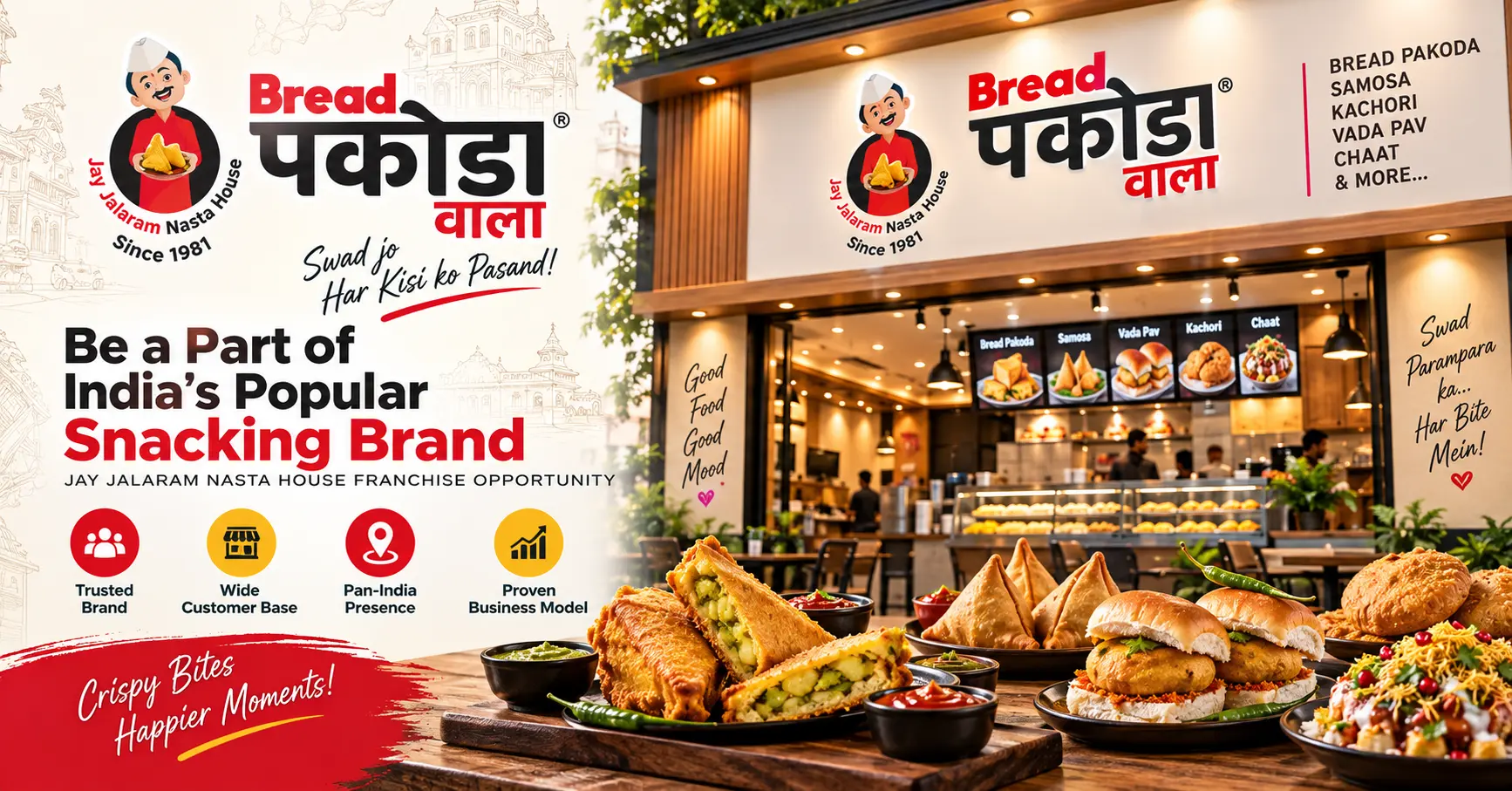
A Bread Pakodawala franchise has an unusual advantage for a new food concept: the product already comes with nearly four decades of local history.
The business behind the brand, Jalaram Nasta House in Chokhandi, Vadodara, traces its bread-pakoda story to 1987. The company says its founder came to Vadodara after working as a pakoda maker in Surat and introduced bread-based pakodas that eventually turned the Chokhandi counter into a well-known local food destination.
Now the brand wants to take that familiarity beyond Vadodara.
Its current franchise page promotes a compact kiosk-to-small-store format, limited city-wise territories and expansion toward Surat, Ahmedabad and additional markets.
But one number is intentionally missing:
the franchise cost.
Bread Pakodawala currently says investment figures are not published online and asks prospective partners to contact the company for city-specific commercial details.
That makes the investment proposal—not an online estimate—the most important document to examine.
Bread Pakodawala Franchise Cost: Not Publicly Disclosed
Unlike several QSR franchises that advertise a fixed entry price, Bread Pakodawala does not currently publish:
- Total investment
- Franchise fee
- Royalty
- Minimum shop area
- Expected monthly turnover
- Gross margin
- Net-profit margin
- Payback period
Its official franchise page explicitly states that investment figures aren’t published online and that the team will explain current numbers according to the applicant’s city.
That means any precise investment figure found on an unofficial franchise portal should not automatically be treated as current Bread Pakodawala pricing.
Before budgeting, ask the company for a written breakup covering:
| Cost | What to Confirm |
|---|---|
| Franchise fee | Upfront brand fee |
| Interiors | Fit-out and branding |
| Equipment | Fryers, refrigeration and preparation equipment |
| Property deposit | Whether additional |
| Initial inventory | Opening food and packaging stock |
| Royalty | Percentage or fixed recurring fee |
| Marketing | Any ongoing contribution |
| Working capital | Recommended cash reserve |
The number that matters isn’t simply the franchise fee.
It is the total cash required to open and keep the outlet running comfortably.
Why the Format Could Keep Investment Lower
Although Bread Pakodawala doesn’t publish a rupee figure, it gives a clear indication of how the business is designed.
The company describes its model as:
“Kiosk to small store — low fit-out, quick to open.”
It emphasizes four elements:
- Compact format
- Tight menu
- Fried-to-order products
- Brand support
The brand says franchisees receive support around recipes, training, packaging and marketing materials.
A compact outlet can potentially reduce some of the biggest expenses associated with full-service restaurants:
- Rent
- Interiors
- Furniture
- Manpower
- Air conditioning
- Large commercial kitchens
But “compact” does not mean every site will have identical economics.
Ask for the exact carpet-area and frontage requirement before taking a property.
The Menu Is Broader Than Bread Pakoda
Despite the brand name, the current menu is much wider than a single signature snack.
Bread Pakodawala currently sells products including:
- Aloo pakoda
- Paneer and cheese pakodas
- Dalwada
- Methi gota
- Bataka bhajiya
- Vadapav
- Sandwiches
- French fries
- Mojitos
- Iced tea
- Shakes
- Cold coffee
Current menu pricing also reflects a value-oriented positioning, with items such as vadapav starting around ₹20 and several pakoda products in roughly the ₹30–₹70 range.
That creates an important franchise consideration.
At relatively affordable selling prices, the business may depend heavily on:
high customer volume + repeat purchases + efficient operations
rather than large margins on a small number of transactions.
“Fried to Order” Is Central to the Model
Bread Pakodawala repeatedly emphasizes that products are prepared fresh rather than left waiting under a warmer.
Its official site says every batch goes into the kadhai when ordered, while the franchise model highlights “fried to order” as one of its key operating principles.
For customers, that can support product quality.
For franchisees, it creates operational questions worth understanding:
- How quickly can orders be produced during peak periods?
- How many fryers are required?
- What oil-management process must be followed?
- How much preparation happens before service?
- How many employees are required during rush hours?
- What wastage level should an efficient outlet target?
A tightly designed menu can simplify training, but execution speed will still matter in a high-volume snack business.
Bread Pakodawala Is Still at an Early Franchise-Expansion Stage
This is one of the most important aspects of the opportunity.
The brand’s current locations page says it lists only counters that are actually operating and currently shows Jalaram Nasta House at Chokhandi, Vadodara as the flagship location.
Its expansion roadmap currently shows:
- Vadodara — Available
- Surat — Coming Soon
- Ahmedabad — Coming Soon
- More cities — Coming Soon
The franchise page also says territories are limited and allotted city by city.
For an investor, early expansion creates both an opportunity and a risk.
The opportunity is securing territory before a market becomes crowded.
The risk is that the franchise network does not yet appear to have the hundreds of operating franchise units available for benchmarking at more mature chains.
Ask for actual operating data wherever the company can provide it.
What Profit Can a Bread Pakodawala Franchise Make?
The current official franchise page describes the concept as a proven business model designed around operational efficiency and profitability.
However, the company does not currently publish a guaranteed:
- Monthly revenue
- Gross margin
- Net profit
- ROI
- Payback period
That means there is no responsible basis for claiming that every Bread Pakodawala outlet will earn a particular amount.
A simple franchise profit model would look like:
Sales
– Food Cost
– Rent
– Staff Salaries
– Electricity/Gas
– Royalty
– Delivery Costs
– Marketing
– Other Expenses
= Operating Profit
Because menu prices are relatively affordable, location and transaction volume could have a major impact on the result.
Location Could Decide Whether the Model Works
Bread Pakodawala describes the franchise as a small-footprint, fast-service, high-repeat model.
That naturally favours sites with repeat footfall.
Potentially relevant locations could include:
- Busy neighbourhood markets
- College areas
- Commercial streets
- Office zones
- Food courts
- Transport-heavy areas
- Dense residential catchments
But don’t choose a site solely because it has high footfall.
The more important equation is:
Expected transactions × average bill value
compared with:
Rent + staff + food cost + other fixed expenses
A very busy location with excessive rent can still produce weak returns.
What Support Does Bread Pakodawala Provide?
The current franchise page specifically lists support around:
- Recipes
- Training
- Packaging
- Marketing kit
It also promotes a focused menu designed to be easier to train and maintain consistently.
Before signing, ask whether the current package also includes:
- Site approval
- Outlet design
- Equipment specification
- Opening support
- Vendor sourcing
- POS software
- Staff recruitment
- Delivery-platform onboarding
- Operational audits
The public page does not currently spell out every one of these areas.
How to Apply for a Bread Pakodawala Franchise
Bread Pakodawala invites investors to contact the franchise team directly for the current city-specific numbers.
The official contact number is:
+91 81281 93143
The company currently states operating/contact hours of 8:00 AM to 10:00 PM daily.
Its flagship location is:
Jalaram Nasta House, Chokhandi, Vadodara, Gujarat.
Because the investment is intentionally not displayed publicly, applicants should obtain the commercial proposal directly from the company before making any payment.
Questions to Ask Before Investing
Before signing a franchise agreement, clarify:
- What is the complete investment for my city?
- What is the upfront franchise fee?
- Does the brand charge royalty?
- What minimum carpet area is required?
- What frontage is preferred?
- Is property deposit outside the quoted investment?
- How much working capital should I reserve?
- Which ingredients must be purchased centrally?
- How many employees does a typical outlet need?
- Is the city territory exclusive?
If the company provides ROI or sales projections, also ask whether they are based on actual operating outlets or forecasts for your location.
Frequently Asked Questions
What is the Bread Pakodawala franchise cost?
Bread Pakodawala currently does not publish its franchise investment online. The company asks prospective partners to contact its team for current city-specific figures.
How much space is required?
The official franchise page describes the model as a kiosk-to-small-store format but does not publicly state an exact minimum square-foot requirement.
Does Bread Pakodawala charge royalty?
The current public franchise page does not disclose a royalty figure. Applicants should confirm all recurring fees directly in the commercial proposal.
What is the franchise profit margin?
Bread Pakodawala does not currently publish a guaranteed profit margin or monthly income figure. Profitability will depend on sales volume, food cost, rent, manpower and other outlet expenses.
When was Bread Pakodawala started?
The Bread Pakodawala story at Jalaram Nasta House in Chokhandi, Vadodara dates to 1987.
Which cities are available?
The current franchise site identifies Vadodara as available, while Surat and Ahmedabad are listed as coming soon. More cities are expected to follow.
The Bottom Line
A Bread Pakodawala franchise combines an old local food story with a very new expansion opportunity.
The brand has served Vadodara since 1987, but its current franchise strategy is only now moving toward additional cities such as Surat and Ahmedabad.
Its compact format, focused menu and relatively affordable products could make the concept interesting for entrepreneurs looking beyond large restaurant investments.
But the biggest financial details are still behind the enquiry process.
There is no public investment, royalty, margin or payback figure.
So don’t make the decision around an unofficial cost estimate.
Get the current city-specific proposal, understand the space and equipment requirements, add property and working-capital costs, and calculate how many daily transactions the outlet needs to break even.
The 1987 legacy gives Bread Pakodawala its story. The unpublished franchise numbers will determine whether it makes sense as an investment today.
Disclaimer: Bread Pakodawala’s current official franchise page does not publicly disclose investment, royalty, margin or payback figures. Franchise terms can vary by city and may change. Prospective franchisees should obtain the latest written commercial proposal and franchise agreement directly from the company before investing.