
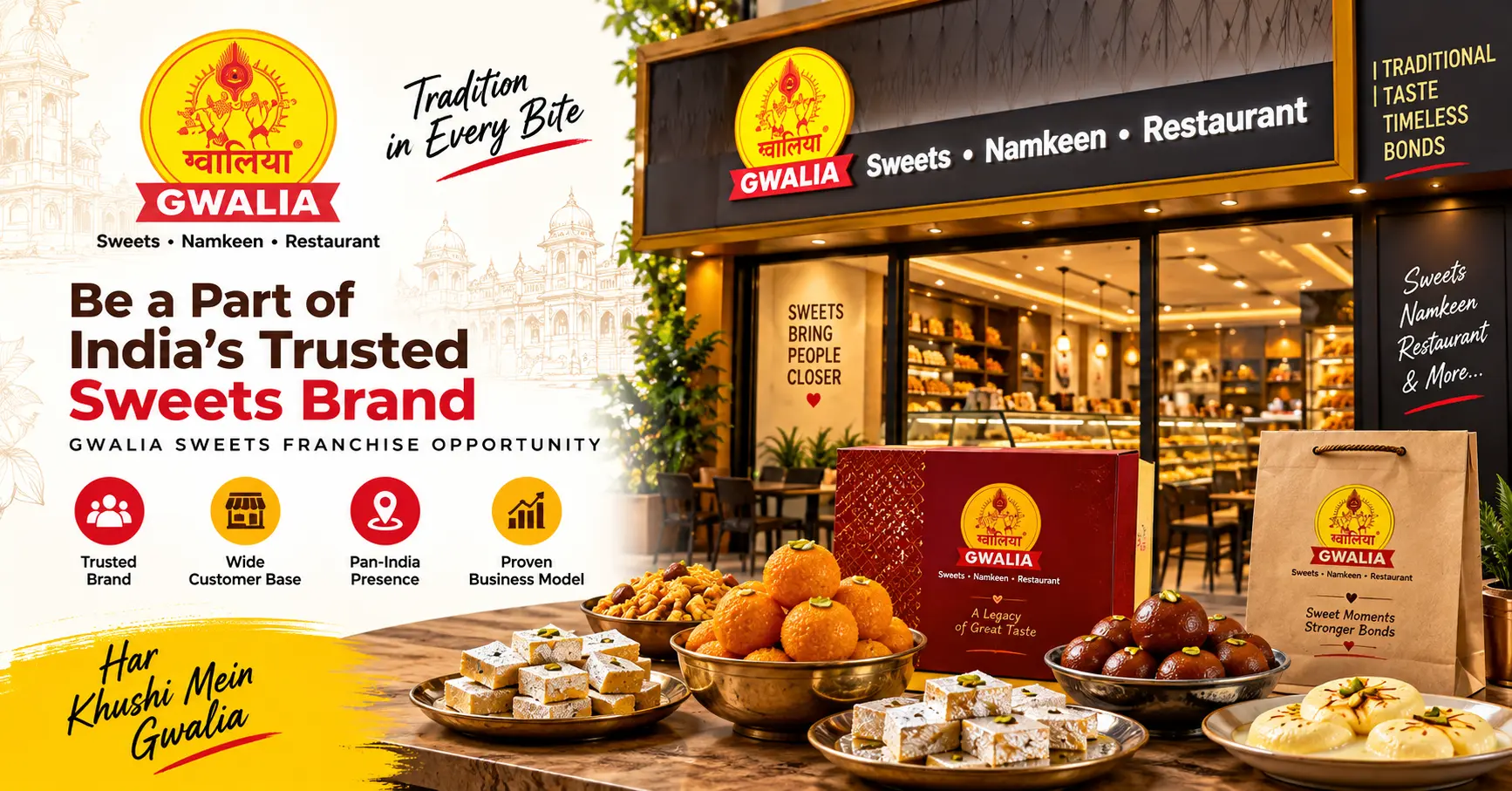
A Gwalia Sweets franchise is not simply a traditional mithai-shop opportunity.
That becomes apparent as soon as you look at the brand’s current business.
Gwalia’s official India site says the company was founded in 1994 and has developed a network of more than 50 outlets, with locations across cities including Ahmedabad, Vadodara, Rajkot, Bhavnagar, Morbi, Mumbai and Bengaluru. The business has also expanded internationally.
But the modern Gwalia format extends far beyond a counter full of kaju katli and laddus.
Its current international restaurant website combines:
- Traditional Indian sweets
- Namkeen
- Chaat
- North Indian food
- South Indian food
- Indo-Chinese dishes
- Snacks
- Beverages
- Takeaway
- Delivery
- Catering
That gives the franchise concept multiple revenue opportunities.
It also makes the economics more complicated.
And prospective franchisees encounter another important issue almost immediately:
Gwalia’s current official franchise page does not publicly state how much the franchise costs.
There is no published franchise fee, royalty percentage, minimum store area, expected turnover, profit margin or payback period on the current page. Instead, applicants are asked how much money they are willing to invest and are told that investment requirements will be discussed during the franchise process.
So before asking whether a Gwalia Sweets franchise is profitable, investors need to answer a more basic question:
What exactly is included in the Gwalia format being offered to you—and what will that particular outlet cost?
Gwalia Sweets Has Been Building the Brand Since 1994
Gwalia Sweets Pvt. Ltd. says it began in 1994, with its first retail outlet at Stadium Circle in Navrangpura, Ahmedabad.
From there, the company expanded into a network of more than 50 outlets across major Indian markets.
The brand also developed beyond traditional retail sweets.
Today, Gwalia’s broader business spans sweets, namkeen, restaurants, catering, gifting and international operations. Its overseas franchise material describes the brand as having more than 30 years of operating history and presence across multiple countries.
For a franchise investor, longevity can matter.
A decades-old food brand potentially brings:
- Established recipes
- Product recognition
- Procurement experience
- Operating systems
- Staff-training processes
- Quality-control standards
- Customer familiarity
But none of those automatically guarantees that a new outlet will generate an attractive return.
The economics of the specific store still matter.
Gwalia Sweets Franchise Cost: The Official Page Doesn’t Publish a Number
This is the most important point for anyone searching for the Gwalia Sweets franchise cost.
The current official franchise page does not publicly state:
- Total investment
- Franchise fee
- Royalty
- Marketing fee
- Minimum working capital
- Required outlet area
- Average monthly sales
- Profit margin
- Break-even period
Instead, Gwalia’s application asks applicants:
“How much money are you willing to invest?”
It also asks:
- How soon they plan to invest
- Which city, state or province they prefer
- Whether they already have a location
- Their annual income
- Business experience
- Existing franchise experience
That suggests Gwalia’s franchise team assesses the investor and location before providing the detailed commercial proposal.
What applicants should not do
Don’t find a precise Gwalia investment number on an unrelated franchise blog and immediately assume it is today’s official price.
Gwalia operates different types of businesses and has an international footprint.
A sweets retail outlet, a full-service restaurant and a larger sweets-plus-restaurant format can require very different levels of capital.
The number that matters is the written quotation for the exact format and market you are applying for.
The Outlet Format Could Change the Investment Dramatically
Gwalia’s current concept combines two businesses that are often operated separately:
Retail sweets and namkeen
and
Restaurant dining.
The official franchise page specifically highlights this as a strength, describing the format’s “dual appeal” of sweets and savoury restaurant food.
That sounds attractive.
It also raises an important investor question:
Are you applying for a sweets store, restaurant, or integrated sweets-and-dining format?
Those options can produce very different cost structures.
A smaller retail-focused outlet may require:
- Sweet display counters
- Refrigeration
- Packaging space
- Storage
- Billing counter
- Limited seating
- Smaller staff
A full restaurant format may additionally require:
- Commercial kitchen
- Exhaust and ventilation
- Larger electricity load
- Dining furniture
- More employees
- Dishwashing area
- Multiple preparation stations
- Larger property
- More working capital
That is why a single “Gwalia franchise cost” can be misleading without knowing the actual outlet model.
Gwalia’s Menu Is Much Larger Than Many Investors May Expect
The current Gwalia menu demonstrates just how broad the concept has become.
Its food categories include:
- Indian snacks
- Parathas
- Pav bhaji
- Chaat
- Punjabi chole
- Rice bowls
- Indian breads
- Sandwiches
- Indo-Chinese food
- South Indian dishes
- North Indian dishes
- Meals
- Desserts
- Beverages
On the sweets side, Gwalia lists product categories including:
- Mawa sweets
- Traditional/desi sweets
- Dry-fruit sweets
- Premium sweets
- Bengali sweets
Its namkeen range includes everything from aloo bhujia and mixtures to Gujarati snacks such as bhavnagari gathiya, bhakharwadi and farsi puri.
This breadth can increase revenue opportunities.
But it can also increase operating complexity.
The Dual Sweets-and-Restaurant Model Is an Advantage—and a Cost Question
Gwalia specifically markets its franchise around the combination of traditional sweets and savoury restaurant fare.
That can make the business less dependent on one type of customer.
For example:
Morning: snacks, tea and takeaway products
Lunch: restaurant meals
Afternoon: chaat and sweets
Evening: family dining and snacks
Festivals: mithai and gift boxes
Special occasions: bulk orders and catering
That creates multiple sales windows throughout the year.
But each sales channel can require additional inventory and operating capacity.
A prospective franchisee should ask:
What percentage of an average outlet’s revenue comes from sweets, restaurant food, namkeen and catering?
That sales mix could tell you a lot about the business.
Festival Sales Could Be Important—but They Can Also Distort the Numbers
Indian sweets businesses can experience enormous seasonal demand around festivals and celebrations.
Gwalia’s current international pages highlight mithai and gift boxes for occasions such as Diwali, Raksha Bandhan and other celebrations, while its outlet pages also accept bulk sweet orders for weddings, religious functions and corporate gifting.
That creates valuable seasonal upside.
However, prospective franchisees should be careful when looking at annual or monthly sales examples.
A store may generate exceptionally strong revenue during a festival month.
That doesn’t mean every month performs at the same level.
If Gwalia provides historical sales information, ask to see:
- Normal-month sales
- Peak-festival sales
- Lowest-month sales
- Average annual sales
This gives a more realistic picture than looking only at the best period.
Sweets Bring Another Important Issue: Wastage
Restaurant food already involves perishable inventory.
A sweets business adds another layer.
Many mithai products use milk solids, paneer, dairy ingredients, nuts and other ingredients that can have limited shelf lives.
That means outlet profitability isn’t determined only by selling price minus ingredient cost.
You also need to consider:
Wastage.
If a store over-orders before a slow week or produces too much stock, unsold product can reduce the effective margin.
Before investing, ask Gwalia:
- Which sweets are produced centrally?
- Which products are produced locally?
- What is the normal shelf life?
- Who decides order quantities?
- Can unsold products be returned?
- Who bears expiry losses?
- What wastage percentage is considered normal?
These may sound like small operating questions.
Across an entire year, they can have a significant financial impact.
Gwalia Says Quality Control Is Part of the Franchise Model
One of the benefits promoted on the official franchise page is a commitment to quality and authenticity, supported by premium ingredients and consistent quality control.
Gwalia also says franchise partners receive access to its established recipes and standardized preparation processes. Its Dubai franchise material similarly highlights complete training, quality standards and continuing operating support.
For a sweets franchise, this is particularly important.
Customers expect a kaju katli or motichur laddu purchased at one Gwalia location to be recognizably similar at another.
Standardization is therefore a major part of brand value.
But franchisees should still ask exactly how the system maintains that consistency.
Ask How Much Product Comes From a Central Supply Chain
The franchise page emphasizes established systems but does not publicly disclose the exact sourcing structure for every outlet.
That needs clarification.
Ask:
- Are sweets supplied from a central production facility?
- Are ingredients supplied centrally?
- Are some items manufactured in-store?
- Are approved suppliers mandatory?
- Can vegetables and dairy be sourced locally?
- Who controls purchase pricing?
- Is freight additional?
- Are minimum orders required?
- Can supply prices be changed during the agreement?
These questions matter because purchasing arrangements influence gross margin.
A franchise can advertise attractive retail prices while the owner’s margin still depends heavily on the wholesale cost charged through the supply chain.
Gwalia’s Restaurant Menu Makes Staffing More Complex
A sweets-only shop might operate with comparatively simple staffing.
A full Gwalia restaurant could be different.
The current food menu spans North Indian, South Indian, chaat and Indo-Chinese dishes.
That potentially means staffing requirements for:
- Restaurant manager
- Cashier
- Sweet counter employees
- Servers
- Chaat preparation
- North Indian kitchen
- South Indian section
- Indo-Chinese section
- Cleaning
- Dishwashing
- Packing and delivery
Not every location will need all these roles separately.
But prospective franchisees should ask Gwalia for a recommended staffing chart based on their proposed format and expected sales.
Labour is one of the largest controllable expenses in restaurant operations.
What Support Does Gwalia Provide?
This is one area where the official franchise page is clearer.
Gwalia says franchisees benefit from:
Comprehensive Training
The company says franchise partners receive training around the established business model.
Its international franchise material expands this to cover recipes, operations, customer service and business management.
Marketing Support
Gwalia says partners can use its brand and marketing resources and receive ongoing marketing assistance.
Quality Control
The franchise proposition emphasizes product consistency, quality standards and authentic recipes.
Ongoing Support
The company’s international franchise information also refers to continuing operational support after launch.
These systems can reduce the trial and error involved in starting an independent sweets-and-restaurant business.
However, applicants should get the exact current support package included in their own franchise agreement.
The Franchise Approval Process Is More Structured Than a Simple Enquiry Form
Gwalia’s current franchise page describes a multi-stage process.
1. Initial Inquiry
Applicants express interest and discuss the franchise opportunity, business model, support and investment requirements with the company.
2. Application
Interested candidates provide detailed information about their background, business experience, finances and location preferences.
3. Discovery Day
Successful applicants may then be invited to a Discovery Day, where they can visit a Gwalia location, meet the team and learn more about the company’s operations and culture.
This is useful for prospective investors.
A Discovery Day shouldn’t be treated simply as a sales presentation.
Use it for due diligence.
What to Ask During Gwalia’s Discovery Day
If you’re invited, prepare questions in advance.
Ask about:
Investment: What is the complete project cost?
Franchise fee: How much is paid upfront?
Royalty: What percentage of sales is charged?
Marketing: Is there a separate marketing contribution?
Store area: What size is required?
Property: Does Gwalia approve the site before leasing?
Supply: Which items are compulsory purchases?
Food cost: What benchmark should an efficient outlet achieve?
Wastage: What is the normal percentage for sweets?
Manpower: How many employees are typically required?
Profitability: What do mature outlets typically generate after store-level expenses?
Working capital: How much cash should remain after launch?
Agreement: What are the term, renewal and exit provisions?
Bring a notebook.
The answers are more valuable than the franchise brochure.
Gwalia Franchise Profit: The Official Site Doesn’t Give a Number
Gwalia describes the sweets-and-restaurant combination as a potentially profitable business model.
But the official page does not publish a guaranteed:
- Monthly profit
- Gross margin
- EBITDA margin
- Net-profit margin
- ROI percentage
- Payback period
That distinction matters.
The word profitable does not mean every outlet produces the same return.
Actual outlet profitability can be simplified as:
Sales
– Cost of Food/Sweets
– Wastage
– Salaries
– Rent
– Royalty
– Utilities
– Delivery Fees
– Marketing
– Maintenance
= Operating Profit
Your store’s figures determine the answer.
A Strong Sweet Margin Doesn’t Automatically Mean Strong Net Profit
Some confectionery products can carry attractive gross margins.
But gross margin is only one layer.
Suppose an outlet has healthy product-level margins but operates from an expensive premium property.
Now add:
- Large staff
- High electricity usage
- Refrigeration
- Wastage
- Delivery commissions
- Franchise royalty
- Marketing charges
The final profit can be much thinner than the gross margin suggests.
Conversely, an efficiently operated location with lower rent may produce a stronger return despite lower turnover.
This is why turnover should never be used as a shortcut for profitability.
Catering Could Become an Important Additional Revenue Stream
Gwalia’s current website specifically promotes catering alongside its restaurant, sweets and namkeen operations.
Its U.S. outlet pages say catering is available for:
- Weddings
- Corporate events
- Private celebrations
- Community gatherings
This can be valuable because catering allows a restaurant kitchen to generate revenue beyond normal table capacity.
But prospective franchisees should confirm whether the franchise agreement gives them local catering rights.
Ask:
- Can the franchise outlet accept catering orders?
- Is catering revenue included in royalty calculations?
- Is there territorial protection?
- Who handles large event production?
- Is a central kitchen involved?
- Can franchisees target corporate clients?
The answers can materially affect the revenue potential of the location.
Gifting and Bulk Mithai Orders Could Be Another Profit Driver
Gwalia’s sweets business also supports gift hampers and bulk mithai orders.
For an outlet located around:
- Corporate offices
- Affluent residential communities
- Wedding markets
- Business districts
this could create additional seasonal and bulk revenue.
Again, ask whether local franchisees receive the full benefit of these orders or whether large accounts are handled centrally.
Location Will Matter More Than Brand Recognition Alone
Gwalia’s India site says outlets are positioned across major business and residential hubs.
That makes sense because the format potentially depends on several different customer missions:
Quick sweet purchase
Family restaurant visit
Snack stop
Takeaway meal
Celebration order
Corporate gifting
A successful location needs enough customers to support those different revenue streams.
Before taking a property, evaluate:
- Residential density
- Family population
- Office catchment
- Parking
- Visibility
- Competitors
- Delivery demand
- Festival shopping patterns
- Monthly rent
- Property deposit
- Restaurant exhaust possibilities
- Power load
And get Gwalia to approve the site before signing a long-term commitment whenever possible.
Gwalia’s International Expansion Adds Opportunity—but Also Complexity
The official India site says Gwalia has had an international presence since 2008 through a global distribution network.
Its UAE franchise site currently describes the business as operating across 4+ countries with 50+ outlets and actively invites franchise applications.
Its North American website currently lists U.S. locations in Frisco and Sugar Land and contact information for Canadian markets.
For investors, this creates one important warning:
Don’t assume franchise terms from one country apply to another.
Indian, UAE, Canadian and U.S. franchise arrangements may have completely different:
- Investment levels
- Franchise fees
- Royalty
- Labour costs
- Property requirements
- Supply chains
- Legal agreements
If you’re investing in India, ask specifically for the current India franchise proposal.
How to Apply for a Gwalia Sweets Franchise
Gwalia’s current franchise page provides an online application.
The form asks for:
- Applicant and spouse details
- Contact information
- Education
- Industry experience
- Existing franchise experience
- Occupation
- Employer/company
- Designation
- Annual income
- Investment capacity
- Investment timeline
- Preferred city/state/province
- Whether you already have a location
For India, Gwalia Sweets Pvt. Ltd.’s official Indian site also provides a contact form that specifically allows enquiries relating to franchise opportunities.
The Indian corporate address is listed as:
Gwalia Sweets Private Limited
401, Sunrise Complex, Mansi Circle,
Near Swaminarayan Temple, Vastrapur,
Ahmedabad, Gujarat – 380015.
Its Indian website also lists:
Email: info@gwalia.in
Customer support: +91 80001 35135
The international contact site lists info@gwaliasweets.com, while some pages display an obvious placeholder email of “info@localhost.” Applicants should therefore use a functioning official Gwalia domain address or the official application form rather than relying on that placeholder.
20 Questions to Ask Gwalia Before You Invest
Because so many commercial numbers are not publicly disclosed, the franchise meeting should focus on filling those gaps.
Ask:
- What is the current total investment for my market?
- Which outlet formats are currently available?
- What is the upfront franchise fee?
- Is GST or other tax additional?
- What royalty applies?
- Is there a separate marketing fee?
- What minimum carpet area is required?
- What seating capacity is recommended?
- What does the store fit-out typically cost?
- Is the rental deposit outside the project estimate?
- Which kitchen and refrigeration equipment is required?
- How much working capital should I reserve?
- What benchmark food cost should the outlet achieve?
- What is the normal sweets wastage percentage?
- Which products must be purchased centrally?
- How many employees are normally required?
- Are catering and corporate gifting rights included?
- What is the franchise agreement duration?
- What renewal and transfer fees apply?
- Is territorial exclusivity provided?
And if Gwalia provides projected sales or ROI, ask:
“Are these figures based on average network performance, selected stores or a projection for my location?”
That distinction matters.
Is a Gwalia Sweets Franchise Worth Considering?
There are several reasons the opportunity deserves attention.
Gwalia says it has been operating since 1994 and has built a network of more than 50 outlets.
The franchise model also offers more than one revenue category.
A single location can potentially generate business through:
- Mithai
- Namkeen
- Restaurant dining
- Street food
- Takeaway
- Delivery
- Catering
- Bulk sweets
- Festive gifting
The company also says franchise partners receive training, marketing assistance, operating support and access to standardized recipes and quality systems.
Those are meaningful advantages.
But the public franchise material leaves several important numbers unanswered:
- Investment
- Franchise fee
- Royalty
- Area requirement
- Working capital
- Sales expectation
- Profit margin
- Payback
Until those numbers are known, it is impossible to properly compare Gwalia with another sweets or restaurant franchise.
Frequently Asked Questions
What is the Gwalia Sweets franchise cost?
Gwalia’s current official franchise page does not publish a fixed investment amount. Instead, applicants are asked how much they are willing to invest, and the company says investment requirements are discussed during the franchise process.
What is the Gwalia Sweets franchise fee?
The current public franchise page does not state an upfront franchise fee. Applicants should request the latest fee directly from Gwalia and confirm whether taxes or other setup charges are additional.
Does Gwalia Sweets charge royalty?
Gwalia’s current franchise page does not publicly disclose its royalty structure. The current percentage and the basis on which it is calculated should be confirmed in the commercial proposal.
What is the Gwalia Sweets franchise profit margin?
The company does not publish a guaranteed net-profit margin on its current franchise page. Actual profitability will depend on sales mix, food and sweet costs, wastage, rent, salaries, franchise charges and other operating expenses.
How much space is required for a Gwalia franchise?
The current franchise page does not publicly state one universal minimum outlet area. The required space may depend on whether the proposed location is a sweets-focused outlet, restaurant or integrated format.
When was Gwalia Sweets started?
Gwalia Sweets Pvt. Ltd. says it was founded in 1994, beginning with an outlet at Stadium Circle in Navrangpura, Ahmedabad.
How many Gwalia outlets are there?
Gwalia’s official India About page says the company has developed a network of more than 50 outlets. Its international franchise material also refers to 50+ outlets and a multi-country presence.
Is Gwalia Sweets only a mithai shop?
No. The current concept also includes namkeen and a broad pure-vegetarian restaurant menu covering chaat, Punjabi food, South Indian dishes, Indo-Chinese food, snacks, beverages and desserts.
Does Gwalia offer catering?
Yes. Catering is promoted on the company’s current website, and its outlet pages describe services for weddings, corporate gatherings and private events.
What support does Gwalia provide to franchisees?
The current franchise material says partners receive comprehensive training, brand and marketing support, continuing assistance, established recipes and quality-control systems.
How does the Gwalia franchise approval process work?
The official process begins with an initial enquiry, followed by a detailed application. Successful applicants may then be invited to a Discovery Day to visit a location, meet the team and learn more about the operation before progressing further.
How can I apply for a Gwalia Sweets franchise?
Applicants can use Gwalia’s official franchise application. For India enquiries, the Gwalia India website also provides a contact form for people interested in a franchise and lists its Ahmedabad corporate office and official contact details.
The Bottom Line
The Gwalia Sweets franchise stands out because it isn’t really just a sweets franchise anymore.
The business that started in Gujarat in 1994 has grown into a network of more than 50 outlets and combines traditional mithai with namkeen, restaurant dining, takeaway, catering and gifting.
That creates multiple ways for a franchisee to generate sales.
It also creates more moving parts.
A full sweets-and-restaurant outlet has to manage inventory, fresh food, perishable mithai, kitchen operations, staff, property costs and seasonal demand.
And while Gwalia’s official franchise page explains the support and selection process, the numbers that ultimately determine the investment decision remain behind the application process.
There is currently no public official figure for the franchise fee, royalty, required investment, profit margin or payback period.
So don’t begin by asking whether a number quoted on a franchise directory sounds affordable.
Begin by finding out which Gwalia format is available for your market.
Get the complete investment breakup.
Understand how the supply chain works.
Confirm the royalty and other recurring fees.
Ask about wastage.
Add the rental deposit and working capital.
And then calculate what the outlet must sell in normal months—not just during Diwali—to justify the total capital.
Gwalia’s 50+ outlet network may get an investor interested. The numbers revealed after the enquiry will determine whether the franchise actually makes financial sense.
Disclaimer: Gwalia’s current official franchise page does not publicly disclose a fixed investment, franchise fee, royalty, minimum store size, profitability or payback figure. Commercial terms may also differ across countries and outlet formats. Prospective franchisees should obtain the latest written proposal and franchise agreement directly from Gwalia Sweets before making any financial commitment.