
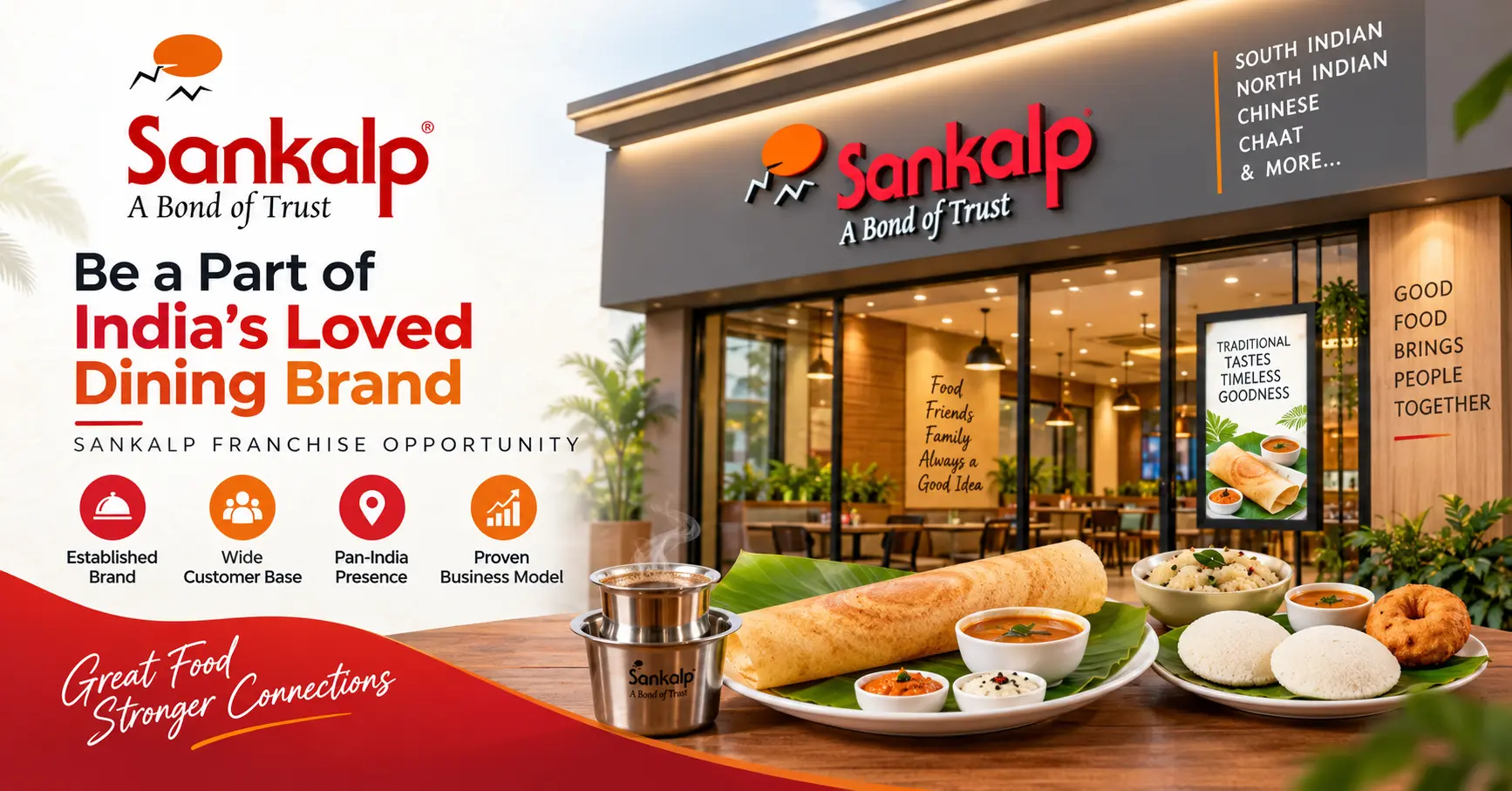
A Sankalp franchise comes with something most new restaurants spend years trying to build: an established name, a tested menu and an operating system already developed for the food business.
But this is not a small kiosk opportunity.
Sankalp Group’s official franchise information places the initial financial commitment for a conventional restaurant at approximately ₹50 lakh to ₹1 crore. More importantly, another official requirements page specifies that this capital requirement is over and above the cost of the property or rental deposits.
That distinction changes the investment calculation considerably.
And it is not the only detail prospective franchisees can miss.
Sankalp does not guarantee returns. It expects franchise owners to be actively involved in the restaurant. A standard outlet can require 1,800–2,500 sq. ft., visibility and parking matter, and different restaurant concepts within the Sankalp Group can have dramatically different space requirements.
So the real question isn’t simply:
“How much does a Sankalp franchise cost?”
It is:
“What will the complete restaurant cost me, and can my location generate enough business to justify that investment?”
Here’s what prospective owners should know.
Sankalp Is More Than One Restaurant Concept
Sankalp Group traces its restaurant business to Ahmedabad, where its first Sankalp restaurant opened in 1980 with a focus on authentic South Indian cuisine. The group currently says it has 250+ restaurants worldwide and has expanded into multiple restaurant concepts.
That matters because applying for a “Sankalp franchise” does not necessarily mean there is only one format to choose from.
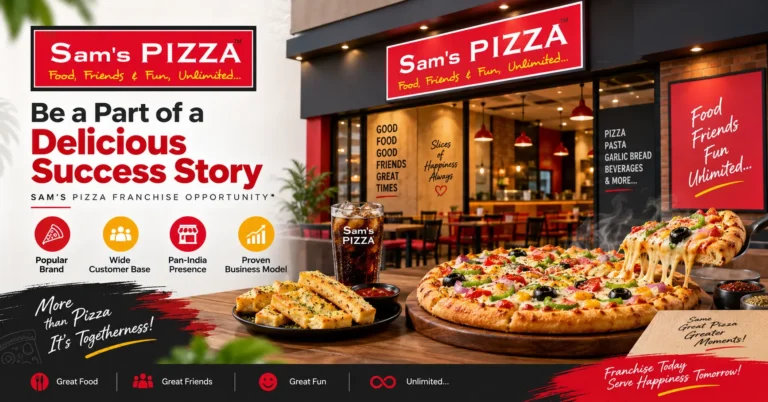
The group’s current franchise information references concepts including Sankalp Restaurant, Saffron, Sam’s Pizza, Southern Vibe and NORF, among others.
Its franchise application form also allows applicants to indicate a preferred restaurant brand, including Sankalp, Saffron BBQ and Sam’s Pizza.
So before comparing costs, first determine which Sankalp Group restaurant concept you actually want to operate.
The investment, location and space requirement may not be identical.
How Much Does a Sankalp Franchise Cost?
For its standard restaurant franchise opportunity in India, Sankalp currently states an initial financial commitment of approximately:
| Requirement | Officially Stated Information |
|---|---|
| Restaurant investment | ₹50 lakh to ₹1 crore |
| Standard restaurant area | Approx. 1,800–2,500 sq. ft. |
| Property cost | Additional |
| Rental deposit | Additional |
| Ground floor | Preferred |
| Frontage | Minimum 40 ft. preferred |
| Parking | Required / valet provision possible |
These figures come directly from Sankalp Group’s franchise and franchise-requirements information.
The ₹50 lakh–₹1 crore range is therefore a useful starting point—but it should not be mistaken for an all-inclusive budget.
The first thing applicants can overlook: the property
Sankalp explicitly states that its investment requirement is over and above the cost of the property or deposits for rentals.
Suppose you find a 2,000 sq. ft. restaurant location that requires a sizeable commercial security deposit.
That amount sits outside the headline restaurant investment.
Depending on the city and locality, you could also face brokerage, advance rent and other property-related expenditure before interior work even begins.
For a restaurant requiring this much space, that can materially alter the amount of capital you need before opening.
Why You May See Different Sankalp Franchise Costs Online
There is another important detail worth knowing.
A separate page on Sankalp Group’s own website contains a disclaimer stating that the minimum investment budget including setup cost, franchise fees and operational expenses is ₹26 lakh plus GST. The same page separately mentions an initial Sankalp franchise investment in the ₹50–₹60 lakh range.
Meanwhile, the group’s main restaurant-franchise and requirements pages quote ₹50 lakh to ₹1 crore for a Sankalp restaurant.
What does this mean for an applicant?
Don’t build your business plan around a number copied from a franchise portal—or even one isolated page.
Sankalp Group now operates several restaurant formats of different sizes. Its current FAQ, for example, says a conventional restaurant generally needs 1,800–2,500 sq. ft., while Southern Vibe requires around 1,000–1,200 sq. ft. and NORF around 200–250 sq. ft.
Different concepts can naturally produce very different project costs.
Before investing, ask Sankalp for a brand-specific written investment breakup for the exact concept and location you are considering.
A 2,000 Sq. Ft. Restaurant Changes the Economics
A standard Sankalp restaurant is not comparable with a 200 sq. ft. takeaway counter.
Sankalp’s stated location profile calls for approximately 1,800–2,500 sq. ft. of carpet area in a prime location.
Ground-floor space is preferred, with approximately 40 ft. of frontage. A first-floor property can also be considered when there is suitable direct access from the ground floor. Parking availability, prominent visibility and strong footfall are also important considerations.
Sankalp says an owned property is preferable, although rented premises may also be considered.
What applicants can overlook here
Finding 2,000 sq. ft. is not the same as finding the right 2,000 sq. ft.
A cheaper restaurant tucked inside a low-visibility property may not be a better investment than a more expensive but commercially stronger site.
Before committing to a property, an investor needs to think about:
Footfall × conversion × average order value × repeat business
Those factors ultimately drive restaurant revenue.
Visibility, parking, nearby residential or office catchments, delivery demand, competition and local spending patterns may all be more important than saving a few lakh rupees during setup.
Sankalp Franchise Profit: The Number You Won’t Find on the Official Page
This is where investors should be careful with third-party claims.
Sankalp describes its model as return-on-investment focused, but its official restaurant-franchise information does not publish a guaranteed monthly profit, fixed net margin or universal payback period.
In fact, Sankalp explicitly says franchise success and ROI depend on factors such as the operator’s hard work, business acumen, leadership and passion for serving customers—and states that success is not guaranteed.
That is a far more useful statement than an online claim promising a specific monthly income.
Restaurant profit ultimately depends on:
Revenue – Food Cost – Staff Cost – Rent – Utilities – Delivery Commissions – Marketing – Maintenance – Other Operating Costs
The final number left over is what matters.
Not revenue alone.
Why High Restaurant Sales Can Still Produce Modest Profit
Imagine two Sankalp restaurants each generating the same monthly revenue.
One has controlled rent, efficient staffing, strong dine-in traffic and limited discounting.
The other pays substantially higher rent, relies heavily on food-delivery aggregators and operates with excessive staffing costs.
Their sales may look identical.
Their net profits can be completely different.
This is particularly important with a ₹50 lakh–₹1 crore restaurant investment because even a profitable outlet may produce an unattractive return if too much capital is tied up relative to the earnings generated.
Before signing a franchise agreement, applicants should calculate both:
Operating profit
and
Return on total capital invested
They are not the same thing.
Which Costs Should You Ask Sankalp to Break Down?
The official website gives the overall investment range but does not publicly provide a complete line-by-line cost structure for every restaurant concept.
That means a serious applicant should request clarity on the following before proceeding:
| Cost Area | What You Should Confirm |
|---|---|
| Franchise fee | Exact fee and applicable GST |
| Interiors | Estimated fit-out cost |
| Kitchen | Equipment and installation budget |
| Furniture | Included or additional |
| Technology | POS/software charges |
| Initial inventory | Opening stock requirement |
| Branding | Signage and brand-standard costs |
| Training | Included costs and any travel/stay expenses |
| Marketing | Launch and ongoing contribution requirements |
| Royalty | Current percentage or fee, if applicable |
| Agreement | Term, renewal and exit conditions |
| Working capital | Recommended operating reserve |
Do not assume an item is included simply because the total investment range looks comprehensive.
A written project estimate is far more valuable than a verbal approximation.
What Support Does Sankalp Provide?
One advantage of buying a franchise instead of opening an independent restaurant is access to established operating systems.
Sankalp says franchise partners receive support across areas including site selection, kitchen layout, restaurant design, branding, equipment selection, recruitment, staff training, vendor support, marketing, software, operating guidelines and quality control.
That is meaningful in a restaurant business.
A first-time restaurant owner otherwise needs to solve each of those problems independently—from finding reliable suppliers to designing kitchen workflow and training service staff.
However, franchise support does not turn the investment into a passive business.
Sankalp itself emphasizes hands-on ownership.
This Isn’t Designed as a Passive Investment
The wording on Sankalp’s franchise page is unusually clear about this point.
The group says restaurant ownership requires a holistic commitment and describes franchisees as being responsible for complex restaurant businesses. It also says franchise operators should be passionate about food and hospitality in a fast-paced environment.
Its selection criteria highlight characteristics such as financial integrity, leadership, business acumen, entrepreneurial spirit and a growth mindset.
So an investor whose plan is simply to provide money, hire a manager and rarely visit the restaurant should examine whether that approach fits Sankalp’s expectations.
Franchising reduces some business uncertainty.
It does not remove management responsibility.
Who Is Sankalp Looking for?
Sankalp’s franchise requirements describe a preferred partner as someone who has interest in the food business, adequate capital, local market knowledge and a business background that can complement the brand.
Those requirements reveal something important.
Having ₹50 lakh or ₹1 crore available does not automatically make someone an ideal franchise candidate.
Restaurant ownership requires people management, financial control, customer service, inventory discipline and local-market understanding.
Capital gets the restaurant built.
Operations determine what happens afterward.
How to Apply for a Sankalp Franchise
Sankalp provides a relatively clear initial application process.
First, applicants fill out the official franchise application.
Sankalp then asks prospective partners to send photographs of the proposed property, including inside and outside views and a view of the main road. The group also requests a layout plan in AutoCAD format as part of its stated property-evaluation process.
Its online application asks for information such as location, preferred brand, investment budget, business experience and property details.
For India franchise enquiries, Sankalp currently publishes:
Phone: +91 98250 27503 / +91 99099 80259
Email: franchisemanager@sankalponline.com
Additional franchise email: franchise@sankalponline.com
Applicants should communicate through official Sankalp Group channels and obtain commercial terms directly from the company.
The Franchise Format You Choose Could Matter More Than You Think
One of the biggest advantages of Sankalp Group’s current restaurant portfolio is that investors are not necessarily restricted to a single full-size South Indian restaurant.
Its current franchise FAQ lists different footprints:
| Concept | Approximate Space Stated by Sankalp |
|---|---|
| Standard Sankalp Group restaurant | 1,800–2,500 sq. ft. |
| Southern Vibe | 1,000–1,200 sq. ft. |
| NORF | 200–250 sq. ft. |
A 200–250 sq. ft. concept has fundamentally different rent, staffing, kitchen and capital economics from a 2,000 sq. ft. full-service restaurant.
That makes brand selection an investment decision—not merely a cuisine preference.
Before saying, “I want a Sankalp franchise,” investors should ask:
Which Sankalp Group concept best fits my market, property and available capital?
Is a Sankalp Franchise Worth the Investment?
There are legitimate reasons the opportunity can be attractive.
Sankalp has operated since 1980, reports more than 250 restaurants worldwide and offers an established restaurant system with support in site selection, operations, training, vendors, marketing and quality control.
For someone who wants to enter the restaurant industry, that infrastructure can remove a significant amount of trial and error.
But the ₹50 lakh–₹1 crore headline investment deserves careful scrutiny.
The strongest franchise opportunity can still become a weak investment when paired with excessive rent, poor site selection, insufficient working capital or unrealistic sales assumptions.
The right question therefore isn’t:
“Is Sankalp a successful restaurant brand?”
It is:
“Can a Sankalp restaurant at my proposed location generate enough sustainable cash flow to justify my total investment?”
That’s the question your financial model needs to answer.
What Most Sankalp Franchise Applicants Should Check Before Investing
Before making a financial commitment, focus on five numbers.
Total capital required: Include the franchise project, property deposit, pre-opening costs and working capital rather than relying only on the ₹50 lakh–₹1 crore headline range.
Expected monthly sales: Build conservative, expected and optimistic scenarios.
Restaurant-level operating margin: Calculate profit after food, labour, rent, utilities, commissions and other recurring expenses.
Break-even point: Determine the monthly sales level needed just to cover operating expenses.
Return on capital: Compare annual operating profit with the total amount of money you actually invested.
A famous restaurant name can improve the starting position.
It cannot change bad unit economics into good ones.
Frequently Asked Questions
What is the Sankalp franchise cost?
Sankalp Group’s primary restaurant-franchise pages state an initial investment of approximately ₹50 lakh to ₹1 crore in India. Its requirements page specifies that property costs or rental deposits are additional. Exact investment depends on the restaurant concept and should be confirmed directly with Sankalp.
How much space is needed for a Sankalp restaurant?
For a conventional restaurant, Sankalp generally states approximately 1,800–2,500 sq. ft. of carpet area in a prime location. Other Sankalp Group concepts can have smaller requirements.
What is the profit margin of a Sankalp franchise?
Sankalp does not publish a guaranteed universal net-profit margin on its main franchise pages. The group explicitly states that success and ROI depend on the operator and are not guaranteed.
Does Sankalp help with location selection?
Yes. Location assistance and site selection are among the support areas listed by Sankalp Group.
Can a Sankalp restaurant operate from rented property?
Yes. Sankalp says owned space is preferred, but rented property can also be considered if it meets the required location parameters.
Does Sankalp provide staff training?
Yes. The group says franchise support includes recruitment and training as well as operating guidance and quality standards.
How can I apply for a Sankalp franchise?
Applicants can use Sankalp Group’s official franchise application and provide information about their proposed location, preferred brand, investment capacity and business experience. Property photos and layout information may also be requested.
The Bottom Line
A Sankalp franchise offers the advantage of entering the restaurant industry with an established brand, operating system and support network already behind you.
But this is still a serious restaurant investment.
The ₹50 lakh–₹1 crore figure is only the beginning of the calculation because property deposits can sit outside it, working capital matters and a standard outlet may require close to 2,000 sq. ft. or more.
And unlike websites promising easy franchise profits, Sankalp itself makes an important point: returns aren’t guaranteed.
That may actually be one of the most useful things a prospective investor can hear.
The brand can provide the recipe, systems and support.
Your location, cost control, team and execution determine whether the numbers ultimately work.
Before investing, get a brand-specific cost sheet, understand every recurring fee, model the restaurant under conservative sales assumptions and calculate the return on your total capital—not just the advertised franchise investment.
Disclaimer: Investment requirements, restaurant formats, fees and commercial terms may change and can vary by brand and location. Figures in this article are based on information currently published by Sankalp Group. Prospective franchisees should obtain the latest written commercial proposal and franchise agreement directly from Sankalp Group before making any financial commitment.