
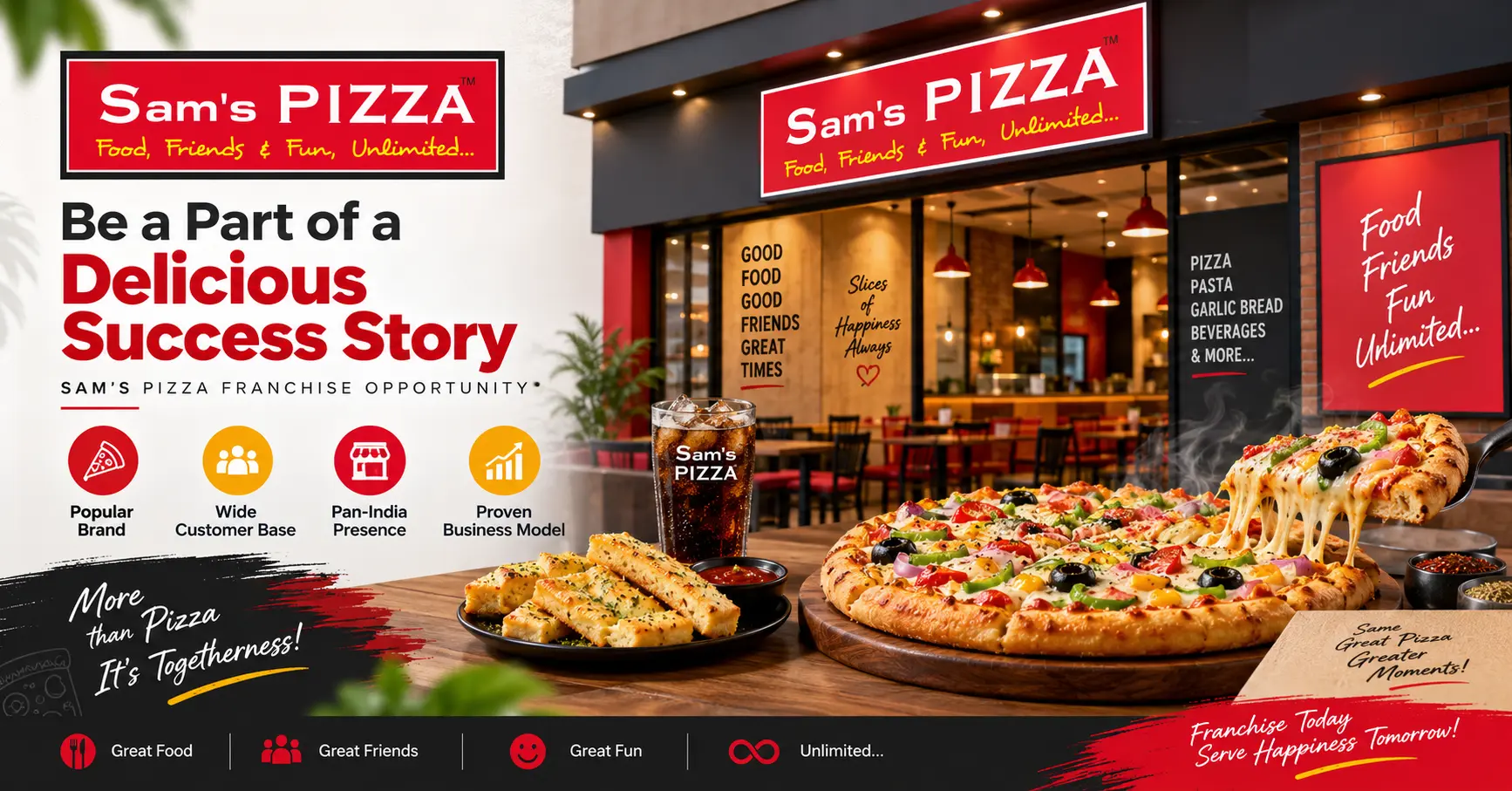
A Sam’s Pizza franchise comes with an interesting proposition: an established pizza restaurant brand, centralized purchasing, training, site-selection assistance and the backing of Sankalp Group.
But there is one number most prospective investors probably want immediately—and Sam’s Pizza does not currently publish it.
The company’s official franchise FAQ says the initial investment varies according to location, restaurant size and local market conditions, with detailed investment requirements provided during the application process. The same page confirms that franchisees also pay ongoing royalty and marketing fees calculated as a percentage of gross sales, but it does not publicly disclose those percentages.
That makes due diligence especially important.
The headline franchise cost isn’t the only number that determines whether a pizza restaurant makes sense. Rent, restaurant size, food cost, staffing, royalty, marketing contributions, delivery commissions and local sales potential can ultimately matter much more.
So before asking whether a Sam’s Pizza franchise is profitable, there are several other questions worth answering first.
What Is the Sam’s Pizza Franchise?
Sam’s Pizza is a pizza and casual-dining restaurant brand owned by Sankalp Group.
The brand’s official website says it currently has 29+ outlets across India and offers franchising opportunities to entrepreneurs. Its concept combines pizza with items such as soups, salads, garlic bread, beverages and desserts, with the brand particularly known for its unlimited-pizza dining proposition.
Sam’s Pizza says its operating system benefits from Sankalp Group’s wider infrastructure in areas including manpower, software, advertising, marketing and branding. It also describes its purchasing process as centralized, helping maintain consistency between outlets.
For someone entering the restaurant business, that is an important advantage.
Starting an independent pizza restaurant means creating recipes, vendor relationships, branding, training procedures and marketing systems from scratch.
A franchise gives you a framework that already exists.
But that framework comes with costs and operating obligations.
Sam’s Pizza Franchise Cost: Why There Isn’t One Public Number
One of the most searched questions is:
How much does a Sam’s Pizza franchise cost?
The most accurate answer right now is that Sam’s Pizza does not publish a fixed investment amount on its current official franchise page.
Its official FAQ specifically says investment varies based on:
- Location
- Restaurant size
- Local market conditions
The franchise development team provides the detailed investment requirement during the application process.
The main franchise page goes only as far as saying the investment is “not very low” but is positioned as lower than many comparable franchise opportunities.
What applicants should not do
You may find websites online quoting specific Sam’s Pizza investment figures.
Those numbers should not automatically be treated as current official pricing.
Restaurant development costs can change considerably with city, property size, kitchen specification, interior standards and equipment requirements.
If the brand itself currently says the investment varies, the safest approach is to obtain a location-specific project cost directly from Sam’s Pizza or Sankalp Group before building your financial model.
The Real Investment Is More Than the Franchise Fee
Even when you receive the franchise quotation, don’t focus only on the franchise or brand fee.
A restaurant investment can include several separate buckets.
Ask for a detailed breakup covering:
| Cost | What to Confirm |
|---|---|
| Franchise/brand fee | Exact upfront amount |
| GST/taxes | Whether quoted costs include taxes |
| Interiors | Required restaurant design and fit-out |
| Kitchen equipment | Ovens, refrigeration and preparation equipment |
| Furniture | Tables, seating and counters |
| Technology | POS and restaurant-management systems |
| Signage | Exterior and interior branding |
| Opening stock | Ingredients and packaging |
| Security deposit | Property-related rental deposit |
| Rent | Monthly lease expense |
| Training | Any associated travel or accommodation costs |
| Launch marketing | Opening campaign expenditure |
| Working capital | Cash required after opening |
What most applicants overlook
Opening the restaurant and operating the restaurant are two different financial requirements.
Even if the complete fit-out is paid for, you still need money to cover wages, rent, food purchases, electricity and other expenses while sales are building.
That reserve is your working capital.
An investor who spends every available rupee on interiors and equipment can start a restaurant with an impressive dining room but insufficient cash to operate comfortably during the first few months.
Sam’s Pizza Charges Royalty and Marketing Fees
This is one of the most important pieces of information on the current official franchise page.
Sam’s Pizza confirms that franchisees pay ongoing:
- Royalty fees
- Marketing fees
These are typically calculated as percentages of gross sales.
The exact percentages are not publicly disclosed on the current page.
That means they should be among the first questions you ask during the franchise discussion.
Why gross-sales fees matter
Suppose your restaurant generates ₹20 lakh in monthly sales.
A fee calculated as a percentage of gross sales is generally payable based on that revenue figure rather than on whatever net profit remains after rent, food and salaries.
This distinction matters.
A restaurant could generate strong revenue but still have pressure on profitability because of:
- High rent
- Food cost
- Payroll
- Discounting
- Delivery commissions
- Royalty
- Marketing contributions
So when calculating Sam’s Pizza franchise profitability, do not evaluate royalty separately.
Include it inside the complete restaurant cost structure.
Sam’s Pizza Franchise Profit: What Does the Company Actually Promise?
Sam’s Pizza talks positively about return potential.
Its official franchise page says centralized purchasing helps franchisees obtain key ingredients at competitive prices and describes operational costs as comparatively lower, supporting what it calls “optimum” return on investment.
But the company does not publish a guaranteed monthly profit, net-profit margin or fixed payback period on its current franchise pages.
That distinction is important.
A pizza franchise’s actual operating profit can be simplified as:
Sales – Food Cost – Labour – Rent – Royalty – Marketing Fees – Utilities – Delivery Costs – Other Expenses = Operating Profit
Every item in that equation can vary significantly by location.
Don’t confuse restaurant sales with franchise income
A restaurant generating ₹25 lakh every month is not giving the owner ₹25 lakh.
Even gross margin isn’t the owner’s final income.
Food, people and property are major expenses in restaurant operations.
Your financial model should therefore focus on the amount left after all operating expenses, not simply on projected turnover.
Your Product Mix Can Influence Profitability
Sam’s Pizza is not exclusively selling individual pizzas.
Its official site describes an offering that can include soups, salads, garlic bread, desserts, beverages and unlimited meal combinations.
This makes menu economics important.
Different items can have different:
- Ingredient costs
- Preparation requirements
- Wastage levels
- Selling prices
- Contribution margins
The unlimited format introduces another operational factor: portion and food-cost control.
The proposition can attract value-focused customers, but a restaurant still needs strong inventory management to ensure that customer value does not translate into uncontrolled food costs.
This is one of the numbers prospective franchisees should discuss with the franchisor.
Ask for historical or benchmark guidance on:
Food cost as a percentage of sales.
Without that number, predicting restaurant profitability is difficult.
Sam’s Pizza Doesn’t Require Restaurant Experience
This is one of the more accessible features of the franchise model.
Sam’s Pizza says previous restaurant experience can be beneficial but is not mandatory. The brand provides training programs for franchisees and staff.
Its main franchise page similarly says that no prior experience is required provided the franchisee follows the brand’s model and systems.
However, “no experience required” should not be interpreted as “no involvement required.”
Sam’s Pizza lists owner involvement among the fundamentals of its restaurant system.
Restaurant businesses require daily attention to:
- Food quality
- Staff attendance
- Customer service
- Inventory
- Wastage
- Cash flow
- Hygiene
- Reviews
- Delivery operations
The franchise provides a system.
The operator still has to execute it.
What Support Does Sam’s Pizza Provide?
The support package is one of the stronger parts of the franchise proposition.
According to the company’s official pages, support can include:
Site selection: Sam’s Pizza says its real-estate team assists franchisees with the location process.
Design and construction: After the lease is signed, its design and construction team provides guidance during outlet setup.
Training: Franchise owners and their teams receive structured training and in-store skill development.
Marketing: The brand says its marketing team assists with advertising campaigns and ongoing promotion.
Operational support: Franchisees receive support intended to help them understand and operate the restaurant system.
Centralized purchasing: The company says centralized sourcing helps maintain product consistency and gives franchisees access to key ingredients at competitive prices.
Technology and logistics: Through Sankalp Group, Sam’s Pizza says it benefits from software, manpower, logistics and broader brand infrastructure.
For a first-time restaurateur, those systems can reduce some of the complexity associated with starting independently.
The Location Decision Can Make or Break the Franchise
Sam’s Pizza specifically says its team assists with site selection, which suggests that location approval forms an important part of the development process.
The current Sam’s Pizza franchise pages, however, do not publicly state a universal minimum floor-area requirement.
That means applicants should avoid signing a long commercial lease before confirming that the property meets Sam’s Pizza’s current specifications.
Before committing to a site, ask about:
- Minimum carpet area
- Minimum frontage
- Ground-floor preference
- Parking requirements
- Exhaust and kitchen requirements
- Power load
- Seating capacity
- Delivery pickup area
- Nearby competition
- Target catchment population
One number to calculate before taking a property
Compare the likely monthly occupancy cost with expected sales.
A busy high-rent location can be attractive.
But paying premium rent only makes sense when the site can generate enough additional contribution margin to justify it.
A famous address does not automatically produce a profitable restaurant.
Delivery Can Increase Sales—and Add Another Cost Layer
Pizza is naturally suited to delivery.
That creates an additional sales channel but also changes restaurant economics.
If a significant part of revenue comes through third-party food-delivery platforms, commissions, discounts, packaging costs and promotional spending can reduce the contribution generated from those orders.
Prospective franchisees should therefore ask Sam’s Pizza for expected channel mix:
- Dine-in
- Takeaway
- Direct delivery
- Aggregator delivery
A location with strong delivery demand can be commercially attractive, but investors should model net realization after delivery-related costs, not simply the menu value of the orders.
How Long Does It Take to Open a Sam’s Pizza Franchise?
Sam’s Pizza’s official FAQ states that the process generally takes around three to five months from initial enquiry to opening, although the timeline can vary depending on site selection, construction and local regulatory requirements.
That timeline is useful for financial planning.
During the pre-opening period, an investor may already be paying expenses such as:
- Rental deposit
- Advance rent
- Construction payments
- Equipment deposits
- Professional fees
So the development timeline itself can affect the total capital required.
Can You Own More Than One Sam’s Pizza Franchise?
Yes.
Sam’s Pizza says qualified franchisees may have opportunities to own multiple restaurants. Its main franchise page also advertises 20+ multi-unit opportunities.
Multi-unit ownership can potentially improve economics by spreading management infrastructure across several restaurants.
But it also magnifies risk.
Opening a second outlet before the first restaurant has proven its unit economics can multiply problems rather than profits.
For new operators, understanding one location thoroughly before expanding can be the more disciplined approach.
How to Apply for a Sam’s Pizza Franchise
Sam’s Pizza provides an online franchise application.
Applicants are asked for information including:
- Name
- Phone number
- Country
- State
- City
- Proposed investment timing
- Total investment budget
The brand says its franchise-development team then provides further information about the opportunity.
The Sam’s Pizza website also directs franchise applicants to parent company Sankalp Group’s franchise application, where Sam’s Pizza – Pizzeria & Salad Bar is available as a preferred business-brand selection.
The official Sam’s Pizza contact page currently lists the franchise enquiry number as:
Franchise Enquiry: +91 98250 27503
Its main corporate contact number is:
+91 79 40710000
Because the website currently displays “info@localhost” in some contact areas, using the official application form or franchise telephone number may be preferable to relying on that displayed email address.
The Questions to Ask Before Paying Anything
This is arguably the most important part of the process.
Before signing the Sam’s Pizza franchise agreement, ask for these figures in writing:
- What is the total estimated project cost?
- What is the franchise fee?
- What royalty percentage applies?
- What marketing fee percentage applies?
- Is GST additional?
- What restaurant area is required?
- What is the typical seating capacity?
- How much working capital is recommended?
- What food-cost percentage should an efficient outlet target?
- What staff strength is typically required?
- What is the average development timeline?
- Are any supplies mandatory from nominated vendors?
- What technology or software charges apply?
- What local marketing expenditure is expected?
- What are the agreement term and renewal conditions?
- Are there territorial protections?
- What happens if the outlet underperforms?
- What exit or transfer restrictions apply?
These answers will tell you more about the opportunity than a single advertised franchise-cost figure ever could.
Is a Sam’s Pizza Franchise Worth Considering?
The opportunity has several attractive characteristics.
Sam’s Pizza has an established operating history, more than 29 outlets according to its current website, centralized purchasing and the infrastructure of Sankalp Group. Franchisees receive assistance with site selection, training, design, construction, marketing and ongoing operations. Prior restaurant experience is not mandatory.
But there are also important unknowns prospective investors need to resolve.
The official franchise page does not currently disclose:
- A fixed initial investment
- Franchise fee
- Royalty percentage
- Marketing-fee percentage
- Minimum floor area
- Expected turnover
- Net-profit margin
- Payback period
That does not make the opportunity unattractive.
It simply means you cannot responsibly evaluate it from the public franchise page alone.
Frequently Asked Questions
What is the Sam’s Pizza franchise cost?
Sam’s Pizza currently does not publish one fixed franchise investment. The official site says the initial investment varies according to restaurant size, location and local market conditions. The franchise-development team provides a detailed estimate during the application process.
What is the Sam’s Pizza franchise profit margin?
The current official franchise pages do not publish a guaranteed profit or net-margin percentage. Profit will depend on revenue, food costs, labour, rent, royalty, marketing fees, delivery costs and other operating expenses.
Does Sam’s Pizza charge royalty?
Yes. Sam’s Pizza says franchisees pay ongoing royalty fees calculated as a percentage of gross sales. The current public page does not state the percentage.
Is there a marketing fee?
Yes. The official franchise FAQ states that ongoing marketing fees also apply and are typically based on a percentage of gross sales.
Do I need restaurant experience?
No. Prior restaurant experience is considered beneficial but is not compulsory. Sam’s Pizza provides franchisee and staff training.
Does Sam’s Pizza help select a location?
Yes. The company says its real-estate team assists franchisees with location selection.
Does Sam’s Pizza provide marketing support?
Yes. Sam’s Pizza says it provides both launch and ongoing marketing support through its marketing team.
How long does it take to open an outlet?
The company’s current FAQ gives an average timeframe of approximately three to five months, depending on location selection, construction and local regulations.
Can I own multiple outlets?
Yes. Qualified applicants can be considered for multi-unit ownership.
How do I apply for a Sam’s Pizza franchise?
Applicants can submit the official Sam’s Pizza franchise form or apply through Sankalp Group’s franchise application and select Sam’s Pizza as the preferred brand.
The Bottom Line
A Sam’s Pizza franchise gives an investor access to an established pizza concept, centralized purchasing, professional training and the wider infrastructure of Sankalp Group.
Those are meaningful advantages.
But the biggest mistake would be deciding whether the franchise is attractive based on an investment number found somewhere else online.
Sam’s Pizza itself currently says costs vary.
It also confirms ongoing royalty and marketing charges while leaving the actual percentages to the franchise discussion.
That makes the commercial proposal—not the marketing page—the document that really matters.
Before signing a lease, ask for the total project cost, required floor area, royalty, marketing fee, estimated restaurant staffing, food-cost targets and working-capital requirement.
Then build your own conservative profit-and-loss projection.
The Sam’s Pizza name and system may help bring structure to the restaurant.
Whether the outlet becomes a good investment will ultimately depend on what remains after every slice of the monthly revenue has been accounted for.
Disclaimer: Franchise investments, fees, restaurant requirements and commercial policies can change and may differ by location. This article is based primarily on information currently published by Sam’s Pizza and Sankalp Group. Prospective franchisees should obtain the latest commercial proposal, fee structure and franchise agreement directly from the company before making any financial commitment.