
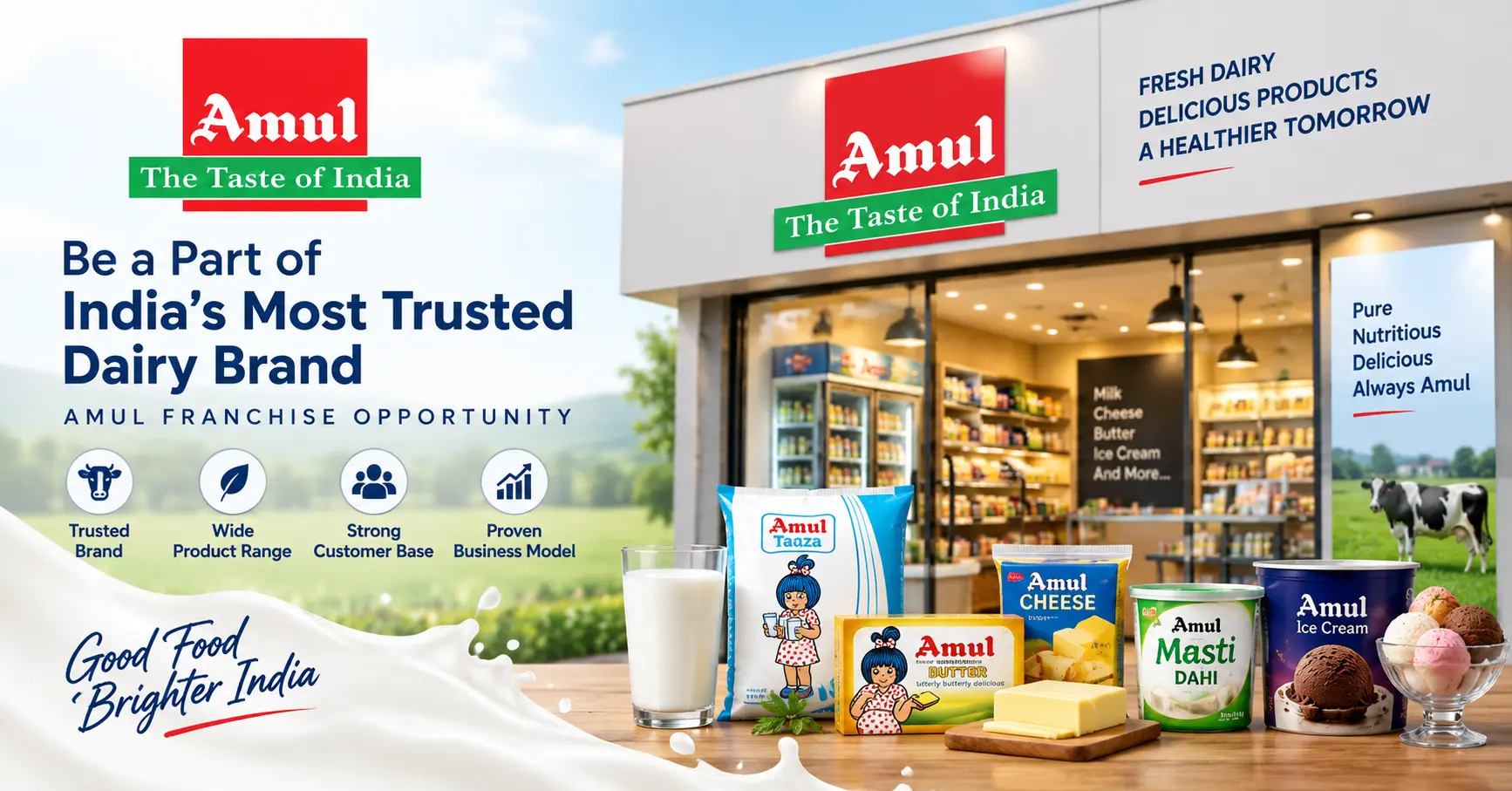
An Amul franchise can look like one of the simplest ways to enter India’s food retail business.
The brand is already familiar. The products are consumed every day. Some outlets need only a relatively small shop, and Amul’s older official franchise information indicates that operators under its parlour model do not have to pay an ongoing royalty or share their retail revenue with the company.
Put those factors together and the opportunity can sound almost straightforward.
But there is another side to the story.
The amount advertised as the franchise investment may not represent the full cash you need. A high monthly turnover does not necessarily mean a high monthly profit. Milk and ice cream can generate very different margins, and even a famous brand cannot rescue a poorly chosen shop with expensive rent.
These are exactly the details a prospective Amul franchise owner should understand before paying a deposit on a property or spending money on interiors.
Here is how the business actually works.
How the Amul Franchise Business Works
An Amul Parlour is a dedicated retail outlet that sells products from the Amul portfolio.
Depending on the format, an outlet may sell fresh milk, butter, cheese, paneer, chocolates, beverages, ice cream, desserts and other Amul products.
Amul currently lists several retail concepts, including:
- Amul Parlour
- Amul Scooping Parlour
- Amul Milk Booth
- Amul COE Parlour
- Amul Railway Parlour
The brand also operates through formats such as cafés, organic stores, chocolate shops, vending machines and other retail concepts. Amul says its dedicated outlets are generally located in high-footfall areas and typically span around 100 to 400 sq. ft.
That relatively compact footprint is one reason the business attracts small entrepreneurs.
But outlet size is only the first number that matters.
Amul Franchise Cost: The Headline Number Isn’t the Whole Investment
Prospective applicants often search for one number: How much does an Amul franchise cost?
There isn’t one universal figure for every Amul outlet.
Amul’s current franchise page explains its retail formats but does not publish a complete current investment table. Its legacy official franchise information, however, gives useful indicative figures for understanding the scale of the opportunity.
| Amul Outlet Format | Indicative Legacy Investment | Indicative Space |
|---|---|---|
| Amul Preferred Outlet / Kiosk / Railway Parlour | Around ₹2 lakh | 100–150 sq. ft. |
| Amul Ice Cream Scooping Parlour | Around ₹6 lakh | More than 300 sq. ft. |
For the smaller format, Amul’s legacy information breaks the approximate ₹2 lakh investment into:
- ₹25,000 refundable brand security
- Around ₹1 lakh for renovation
- Around ₹70,000 for equipment
- Additional incidental expenditure
For an Amul Ice Cream Scooping Parlour, the same official source lists an indicative investment of around ₹6 lakh, including brand security, renovation and equipment.
What many applicants overlook
Property cost is not included in those headline figures.
Neither is the full amount of working capital you may require.
So seeing “₹2 lakh Amul franchise” online should not lead you to assume that ₹2 lakh is all you need to open the doors and keep the business running.
Your actual financial requirement can also include:
- Rental security deposit
- Monthly shop rent
- Initial inventory
- Working capital
- Employee salaries
- Electricity
- Refrigeration expenses
- Maintenance
- Local registrations or licences
- Miscellaneous operating costs
Amul’s legacy information specifically states that working capital is additional and recurring costs such as shop rent, staff and electricity are borne by the franchisee.
That difference between setup cost and total capital required is one of the most important things to understand before investing.
Amul Franchise Profit Margin: Not Every Product Pays the Same
Another number that can easily be misunderstood is the profit margin.
Amul’s older official franchise information lists approximate average retail returns on MRP of:
| Product Category | Indicative Margin |
|---|---|
| Pouch Milk | Around 2.5% |
| Milk Products | Around 10% |
| Pre-packed Ice Cream | Around 20% |
| Certain Recipe-Based Items | Around 50% |
Recipe-based products mentioned for scooping parlours include items such as ice-cream scoops, sundaes, shakes and selected prepared foods.
At first glance, margins of up to 50% can sound extremely attractive.
But that is not a 50% net profit on the entire Amul franchise.
It relates to certain products.
Milk, by comparison, has historically carried a much smaller retail margin.
What many applicants overlook
Two Amul outlets with exactly the same monthly turnover could generate very different gross margins depending on what customers actually buy.
Consider a simplified example.
Suppose Outlet A sells ₹6 lakh worth of products in a month, with most of its sales coming from low-margin daily essentials.
Outlet B also sells ₹6 lakh but has a stronger mix of ice cream and higher-margin products.
Outlet B may generate considerably more gross margin despite reporting exactly the same turnover.
That is why asking only “How much does an Amul franchise sell?” is the wrong question.
You also need to ask:
“What products will generate those sales?”
₹5 Lakh in Sales Doesn’t Mean ₹5 Lakh Is Coming to You
Amul’s legacy franchise information says expected monthly turnover can vary from one location to another and historically indicated around ₹5 lakh to ₹10 lakh per month for certain parlours.
Turnover, however, is not income.
Imagine an outlet generates ₹7 lakh in monthly sales.
The owner first earns the applicable retail margins across the different products sold. From that gross margin must come expenses such as:
- Rent
- Salaries
- Electricity
- Maintenance
- Local operating expenses
Only what remains after those expenses can be considered operating profit.
So:
Net Profit = Gross Retail Margin – Operating Expenses
This distinction is particularly important in franchise articles because sales figures can look impressive while telling you very little about what the franchise owner actually takes home.
The Location Could Matter More Than the Franchise Fee
Amul says its parlours are positioned in areas such as prime markets, educational institutions, hospitals, railway stations, bus terminals, residential locations and commercial hubs.
There is a reason for that.
Dairy and ice-cream retail depends heavily on convenience and repeat footfall.
A customer may travel across town for a famous restaurant. They are much less likely to travel several kilometres simply to buy a pouch of milk.
An Amul outlet therefore benefits from being close to where consumers already live, work, study or travel.
Before choosing a shop, check:
- Daily pedestrian footfall
- Residential density
- Nearby colleges and offices
- Shop visibility
- Road access
- Parking or stopping convenience
- Nearby dairy and ice-cream competitors
- Supermarkets and convenience stores
- Local delivery competition
- Monthly rent
- Seasonal customer traffic
And this is another area where applicants can make an expensive mistake.
A “premium” location with ₹50,000 monthly rent is not automatically better than a neighbourhood shop costing ₹20,000.
If the expensive property does not generate enough additional gross margin to cover the extra rent, higher sales may still leave the owner with less profit.
Which Amul Franchise Format Makes the Most Sense?
There isn’t one best format for everybody.
Amul Preferred Outlet / Parlour
This is the more conventional dedicated Amul store.
It can suit entrepreneurs looking for a compact outlet selling a broad portfolio of dairy products, beverages, chocolates and ice creams.
It may work well in residential neighbourhoods, markets, hospitals and educational areas.
Amul Milk Booth
A milk booth is a compact format focused more heavily on fresh milk and essential dairy products. Amul describes it as a cost-effective neighbourhood convenience format.
The potential advantage is frequent repeat demand.
The challenge is that some essential products can carry lower margins.
Amul Scooping Parlour
This format is more dessert-focused.
Amul describes scooping parlours as outlets offering ice creams, sundaes, milkshakes and desserts.
It requires a larger investment than a basic outlet but may provide access to a higher-margin product mix.
That can make it particularly interesting in locations with strong youth, family or evening footfall.
Amul Railway Parlour
This format serves customers in railway locations.
However, a railway parlour should not be treated like an ordinary roadside shop. Location permissions and railway allotment requirements can be relevant.
No Royalty Sounds Great – but Don’t Stop Your Calculation There
One attractive feature in Amul’s legacy official franchise model is that the franchisee does not pay royalty or share retail revenue with Amul.
Instead, dealers supply stock to the parlour and the franchise operator earns the applicable retail margin.
For entrepreneurs comparing Amul with restaurant franchises that charge ongoing royalty fees, this can be a significant advantage.
But “no royalty” should not be interpreted as “low operating costs.”
You still need to pay for the actual running of the outlet.
And if rent, staffing and electricity consume most of your gross margin, the absence of royalty alone will not make the outlet financially attractive.
How to Apply for an Amul Franchise
The safest approach is to deal directly with Amul through its official channels.
A typical process begins with identifying a suitable shop and preparing details about:
- Shop size
- Exact location
- Ownership or rental status
- Catchment area
- Nearby commercial activity
- Photographs of the proposed location
You can then approach Amul regarding a franchise/parlour opportunity.
Amul currently publishes the following contact details for retail enquiries:
Email: retail@amul.coop
Amul Channel Care: 022 6852 6666
If the location and proposal are suitable, the company can provide further information about the relevant format and next steps.
One Thing You Definitely Shouldn’t Overlook: Franchise Scams
Amul franchise searches have also attracted fraudulent websites and people pretending to represent the company.
Amul explicitly warns the public against fake websites using its brand, logo or address to offer fraudulent opportunities and tells people not to send money or disclose banking information to unauthorized parties.
Its official franchise FAQ goes further.
Amul states that it does not charge a registration fee for a franchise or distributorship and advises applicants against making online or NEFT payments simply because someone claiming to represent the company requests one.
Amul also recommends checking whether communication from a purported representative comes from an official address ending in @amul.coop.
So if a website promises “guaranteed Amul dealership approval” after an immediate payment, treat that as a serious warning sign.
Is an Amul Franchise Actually Worth It?
It can be – but not simply because Amul is a huge brand.
The opportunity has several clear strengths:
- Strong consumer recognition
- Everyday demand for dairy products
- Multiple outlet formats
- Compact shop requirements for some formats
- Broad product portfolio
- Established product distribution
- No ongoing royalty under the legacy parlour model
But the economics still need to work at your specific location.
Before committing money, calculate:
Expected customers per day × average bill value = estimated daily sales
Then estimate the sales split between milk, dairy products, ice cream and higher-margin items.
Apply realistic gross margins.
Finally subtract:
Rent + salaries + electricity + maintenance + other monthly costs
Run the numbers under three scenarios:
- Strong sales
- Expected sales
- Weak sales
The third scenario may tell you more about the quality of the investment than the first.
What Most Amul Franchise Applicants Should Check Before Investing
The Amul brand can bring customers to the door, but the following questions determine whether the outlet could make financial sense:
Is the quoted franchise figure the total investment?
Usually not. Property-related expenses and working capital can be additional.
What will my rent-to-sales ratio look like?
High rent can quickly eat into relatively thin retail margins.
Which products are likely to drive my sales?
Product mix matters because margins vary considerably by category.
How much cash do I need beyond store setup?
You need enough working capital to operate while the business builds demand.
Is the person contacting me really from Amul?
Verify them through official Amul channels before making any payment.
Am I comparing turnover with profit?
Never treat monthly sales as the owner’s earnings.
These questions are far more useful than simply asking whether an Amul franchise is “profitable.”
Frequently Asked Questions About Amul Franchise
How much does an Amul franchise cost?
Amul’s legacy official franchise information indicates around ₹2 lakh for an Amul Preferred Outlet, kiosk or certain railway formats and around ₹6 lakh for an ice-cream scooping parlour. Working capital and property-related costs can be additional. Confirm the latest terms directly with Amul.
What is the Amul franchise profit margin?
Legacy Amul information lists indicative average margins of around 2.5% on pouch milk, 10% on milk products and 20% on pre-packed ice cream. Certain recipe-based scooping-parlour products were indicated at around 50%. These are gross product-level margins rather than guaranteed net profits.
How much can an Amul franchise owner earn?
There is no fixed income. Earnings depend on sales, product mix, rent, salaries, electricity and other operating costs.
Does Amul charge royalty?
Amul’s legacy official franchise page says parlour franchisees do not need to pay royalty or share retail revenue with Amul. Applicants should still confirm the terms of their current agreement before investing.
How much space is required?
Amul’s current retail page says its outlets typically span approximately 100 to 400 sq. ft., depending on the franchise format.
Can I open an Amul franchise in a rented shop?
Amul’s legacy franchise information states that a franchisee may have a prebuilt shop in a suitable location that is either owned or rented.
Does Amul charge a franchise registration fee?
Amul says it does not charge registration fees for its franchise or distribution opportunities and warns applicants against sending unauthorized online payments.
How do I apply for an Amul franchise?
Contact Amul through its official retail enquiry channels and submit details of your proposed location. Amul currently lists retail@amul.coop and 022 6852 6666 for parlour/franchise enquiries.
The Bottom Line
An Amul franchise has something many new retail businesses spend years trying to build: customer familiarity from day one.
That is a major advantage.
But the Amul name is only one part of the business equation.
The more important numbers may be the rent you agree to pay, the products your customers buy, the gross margin those products generate and the working capital you keep aside.
The headline franchise cost can get your attention.
The unit economics will decide whether the outlet works.
So before opening an Amul Parlour, don’t stop at asking how much it costs.
Find out what it could realistically leave in your pocket after every expense is paid.
Disclaimer: Investment amounts, margins and sales figures mentioned in this article are based partly on indicative information published on Amul’s legacy official franchise pages. Commercial terms, outlet formats and policies may change. Applicants should obtain the latest information and written terms directly from Amul/GCMMF before making any financial commitment.