
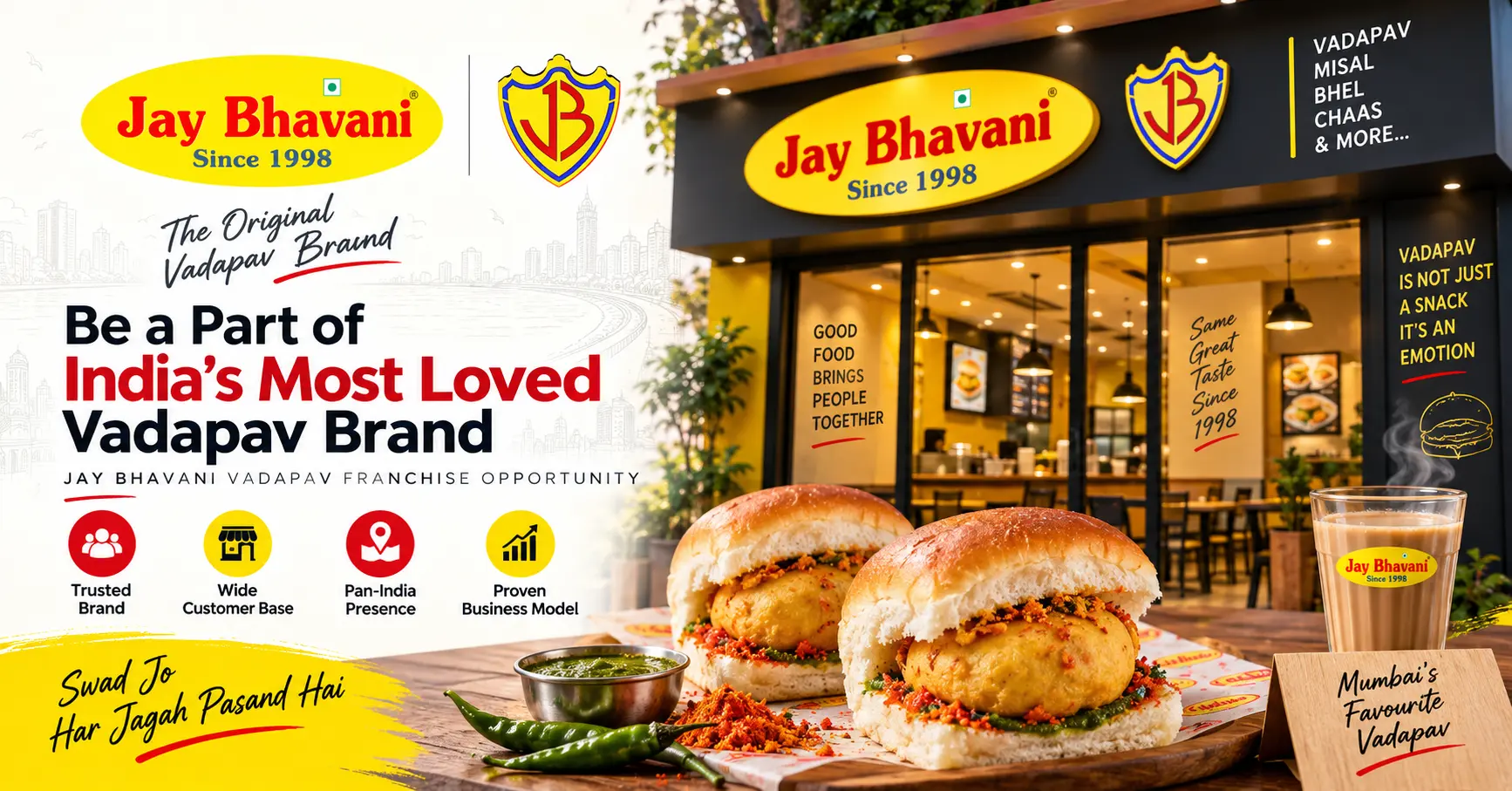
A Jay Bhavani Vadapav franchise comes with a business story that almost sounds designed for aspiring food entrepreneurs.
According to the company’s official history, Jay Bhavani began in Ahmedabad in 1998 as a food cart started with just ₹5,000 in capital, selling vadapav for ₹4 a piece. The business later moved from the pavement to permanent outlets and eventually into franchising. Today, its website says the brand has grown to 195+ outlets across India, Canada, the United States and Australia.
That journey makes the franchise opportunity easy to notice.
But if you visit Jay Bhavani’s current official franchise page looking for the numbers that normally decide an investment, you won’t find them.
The current application asks about your business experience, annual income, city, proposed area and floor—but it does not publicly state:
- Total franchise investment
- Franchise fee
- Royalty percentage
- Minimum store size
- Expected sales
- Profit margin
- Payback period
And that creates the most important question for a potential franchisee:
How much does it really cost to join Jay Bhavani today—and which numbers should you get in writing before committing to a property?
How Jay Bhavani Grew From a Cart to a Franchise Network
Jay Bhavani’s official timeline traces the business back to Ahmedabad’s C.G. Road.
The company says its first food cart opened in 1998. A permanent outlet followed near GLS College in 2004, further expansion took place through Ahmedabad, and the company’s first franchise was created in 2014 by converting its Palanpur company-owned outlet.
The brand later expanded outside Gujarat, with its 101st outlet opening in Udaipur in 2018.
By 2024, Jay Bhavani said it had 195+ outlets across India and several overseas markets.
That scale matters for a franchise investor because it suggests Jay Bhavani has already developed experience with multi-location operations rather than offering an entirely new franchise concept.
But brand size alone cannot tell you whether a new outlet will be profitable.
That depends on the commercial terms.
Jay Bhavani Vadapav Franchise Cost: The Current Site Doesn’t Publish It
This is the first thing prospective investors should understand.
Jay Bhavani’s current official franchise page does not state a minimum investment.
Instead, the company asks interested applicants to submit information including:
- Name
- Date of birth
- Existing business
- Designation
- Experience
- Annual income
- Contact details
- City and state
- Proposed area
- Floor
That suggests the franchise conversation is partly applicant- and location-specific.
But you may find detailed numbers elsewhere online
An older Jay Bhavani franchise proposal circulating online lists three formats:
| Legacy Format | Legacy Franchise Fee | Legacy Royalty | Legacy Space |
|---|---|---|---|
| Express | ₹3.5 lakh + GST | 4% + GST | 150–400 sq. ft. |
| Special | ₹6 lakh + GST | 5% + GST | 400+ sq. ft. |
| Premium | ₹8 lakh + GST | 6% + GST | 800+ sq. ft. |
The same older proposal states that investment started from around ₹10 lakh, while emphasizing that costs could increase or decrease according to the location and size of the outlet.
These figures are useful for historical context.
They should not be treated as confirmed current franchise pricing.
The proposal itself says it is only a proposal and that final terms would be governed by a later franchise agreement. Jay Bhavani’s current official website no longer displays these numbers publicly.
So the safest approach is simple:
Ask Jay Bhavani for a fresh commercial proposal before using any online figure in your business plan.
Why the Old ₹10 Lakh Number Can Be Misleading
“Investment starts from ₹10 lakh” sounds simple.
A restaurant or QSR project rarely is.
Even if that figure once represented a starting project cost for a smaller format, your actual capital requirement can include several separate expenses.
You should ask for clarity on:
| Cost Area | What to Confirm |
|---|---|
| Franchise fee | Current amount and GST |
| Interiors | Brand-standard fit-out cost |
| Equipment | Kitchen, refrigeration and preparation equipment |
| Signage | Exterior and internal branding |
| Property deposit | Rental security and advance rent |
| POS/software | One-time and recurring costs |
| Initial stock | Opening inventory |
| Licences | FSSAI and local statutory approvals |
| Training | Whether any costs are additional |
| Launch marketing | Opening promotion requirement |
| Royalty | Current percentage and tax treatment |
| Working capital | Recommended operating reserve |
What applicants often overlook
Setup investment and total cash requirement are not the same thing.
If you spend all available capital on interiors and equipment, you can still run into trouble after opening.
You need money for:
- Staff salaries
- Rent
- Electricity
- Stock replenishment
- Delivery expenses
- Local marketing
- Unexpected repairs
- Slow initial sales
Working capital can be just as important as the franchise fee.
Is Jay Bhavani Still Using Express, Special and Premium Formats?
The older proposal clearly refers to Express, Special and Premium modules.
However, the current official franchise page does not publicly describe these formats or confirm their latest commercial terms.
That distinction matters.
Do not assume that a historical 150–400 sq. ft. Express model, a 400+ sq. ft. Special outlet or an 800+ sq. ft. Premium outlet is still offered on exactly the same terms.
When contacting the company, ask:
Which franchise formats are currently available in my city?
Then request the current requirements for each format.
A smaller outlet and a large-format store can have very different:
- Rental costs
- Staffing needs
- Menu capacity
- Equipment requirements
- Seating
- Delivery potential
- Total investment
Choosing the format should therefore follow the market opportunity—not simply the lowest franchise fee.
Jay Bhavani Is No Longer Just About Vadapav
The brand name might suggest a highly focused vadapav business.
The current menu tells a different story.
Jay Bhavani’s official website lists categories including:
- Vadapav
- Exotic vadapav
- Dabeli
- Pav bhaji
- Pulav
- Chinese
- South Indian
- Maska bun
- Milkshakes
- Juice
- Pizza
- Puff
- Maggi
- Burgers
- Hot dogs
- Sandwiches
- Chaat
- Fries
- Rice bowls
- Desserts
- Coffee
- Pasta
- Wraps
That breadth can be commercially useful.
It means an outlet isn’t dependent on customers buying one inexpensive snack.
A wider menu can increase average order value and serve different eating occasions.
But it also makes operations more complex.
The Huge Menu Could Be a Profit Driver—or a Cost Problem
A menu covering vadapav, pizza, Chinese food, South Indian items, milkshakes and sandwiches needs considerably more operating discipline than a single-product kiosk.
A franchisee should examine:
Food cost: What percentage of sales goes into ingredients?
Inventory: How many different raw materials must be stocked?
Wastage: Which ingredients expire quickly?
Kitchen layout: How many preparation stations are required?
Manpower: How many employees are needed for a full menu?
Training: Can every outlet reproduce the same product consistently?
Sales mix: Which menu items actually produce the strongest contribution margin?
The answer to those questions may matter more to profitability than the price of the franchise licence itself.
What Does Jay Bhavani Say About ROI?
Jay Bhavani talks positively about return on investment.
Its official About page says the company has focused on becoming a volume player with tight pricing control and states that this approach is designed to help franchise partners achieve faster returns and expand to multiple locations.
But the current official website does not publish a guaranteed ROI percentage, monthly net profit or fixed payback period.
That difference matters.
“Faster ROI” is a business objective.
It is not a promise that every franchise will recover its capital within a particular number of months.
A realistic calculation is:
Monthly Sales – Food Cost – Salaries – Rent – Royalty – Utilities – Marketing – Delivery Costs – Other Expenses = Operating Profit
Then compare annual operating profit with the total capital invested.
Don’t Confuse Sales With Franchise Profit
Suppose a Jay Bhavani outlet generates ₹12 lakh in monthly sales.
That ₹12 lakh is revenue.
It is not what the owner takes home.
From revenue must come expenses such as:
- Raw material
- Salaries
- Rent
- Electricity
- Royalty
- Packaging
- Delivery aggregator commissions
- Repairs and maintenance
- Marketing
- Taxes where applicable
Only the amount remaining after operating costs can be considered operating profit.
This distinction becomes even more important when comparing different locations.
An outlet with higher sales but extremely high rent can potentially generate less profit than a lower-turnover store with better cost control.
Royalty Is One Number You Must Verify
The historic franchise proposal listed royalties of:
- 4% + GST for Express
- 5% + GST for Special
- 6% + GST for Premium
Again, those should be regarded as legacy figures, not confirmed current terms.
Jay Bhavani’s present franchise page does not publish its latest royalty structure.
Before investing, ask:
- What is the current royalty?
- Is it calculated on gross sales?
- Is GST additional?
- Is there a minimum monthly royalty?
- Is there a separate marketing contribution?
- Are software fees additional?
- Are there mandatory raw-material purchases?
Even a small change in royalty percentage can materially change annual franchise profit.
Location Matters Especially for a Value-Focused Food Brand
Jay Bhavani’s story began with affordable street food and the company describes itself as a volume-focused business.
That makes customer traffic particularly important.
Potential locations may include:
- College areas
- High streets
- Dense residential markets
- Office districts
- Food courts
- Transport locations
- Shopping areas
- High-delivery-demand neighbourhoods
But the correct site should not be chosen on footfall alone.
You also need to examine:
Rent per month
Expected customers per day
Average bill value
Dine-in versus takeaway mix
Delivery potential
Competition
Parking
Visibility
Operating hours
The ideal location is not necessarily the busiest.
It is the location where customer demand is high enough relative to the occupancy cost.
What Support Has Jay Bhavani Historically Offered?
The older franchise proposal described support including:
- Outlet blueprint and design
- Product and service training
- Business best-practice guidance
- Promotional assistance
- Raw-material and equipment support
- Billing-software support
- Ongoing operational assistance
The proposal also placed responsibility on the franchisee for operations, quality, hygiene, staffing, customer satisfaction, local marketing, fees and statutory licences.
This gives useful insight into the model historically used by Jay Bhavani.
However, because these details are not laid out on the current franchise page, applicants should ask the company to confirm the present support package in writing.
How to Apply for a Jay Bhavani Vadapav Franchise
Jay Bhavani currently provides a franchise enquiry form on its official website.
The form asks about your personal profile, business experience, income and proposed location.
The company’s official Contact page currently lists:
Franchise Enquiry: +91 75758 05500
Email: franchise@jbvindia.com
Office: The Capital 2, Science City Road, Sola, Ahmedabad, Gujarat
Using these official channels is preferable to relying on third-party franchise brokers.
The 15 Questions to Ask Before Investing
Before paying any fee, ask Jay Bhavani to confirm:
- What is the current total project investment?
- Which outlet formats are currently offered?
- What is the franchise fee for each format?
- What royalty applies?
- Is there a marketing fee?
- What minimum carpet area is required?
- What frontage is preferred?
- What equipment must be purchased?
- Which raw materials are compulsory from the company?
- What working capital does Jay Bhavani recommend?
- How many employees are normally required?
- What food-cost percentage should an efficient outlet achieve?
- What training is included?
- What is the franchise agreement duration?
- Is territorial exclusivity provided?
If the brand provides sales or ROI examples, also ask whether the figures represent:
- Network averages
- Selected high-performing outlets
- Mature stores
- New stores
- Projections
That context can completely change the meaning of the number.
Is a Jay Bhavani Vadapav Franchise Worth Considering?
There are several reasons to investigate it.
Jay Bhavani has been operating since 1998, says it has grown to more than 195 outlets and has expanded internationally. It also has a broad menu rather than relying exclusively on its signature vadapav.
The brand’s history also demonstrates that franchising is not a new experiment for the company; its official timeline traces the first franchise conversion to 2014.
But several important commercial details remain unpublished on the current franchise page.
That means a serious investor still needs direct answers on:
- Current investment
- Current franchise fee
- Royalty
- Outlet size
- Setup cost
- Working capital
- Profit expectations
- Agreement terms
Without those numbers, comparing Jay Bhavani with another QSR franchise is difficult.
Frequently Asked Questions
What is the Jay Bhavani Vadapav franchise cost?
The current official franchise page does not publish a fixed investment. An older franchise proposal circulating online stated that investment started from around ₹10 lakh, but this should be treated as historical information rather than confirmed current pricing. Obtain a fresh quotation directly from Jay Bhavani.
What is the Jay Bhavani franchise fee?
A legacy proposal listed fees between ₹3.5 lakh and ₹8 lakh plus GST depending on the outlet format. The current official website does not confirm those figures, so applicants should verify the latest fee directly with the company.
How much space is required?
The older proposal mentioned 150–400 sq. ft. for Express, 400+ sq. ft. for Special and 800+ sq. ft. for Premium outlets. These are legacy specifications and should be reconfirmed before taking a property.
What is the Jay Bhavani Vadapav franchise profit margin?
Jay Bhavani’s current official site does not publish a guaranteed net-profit margin. Profit depends on sales, food costs, rent, staffing, royalty, delivery expenses and other operating costs.
Does Jay Bhavani charge royalty?
A historical franchise proposal listed royalty rates of 4%, 5% and 6% plus GST depending on the format. The current official franchise page does not publish updated royalty terms, so verify the current agreement directly.
How many Jay Bhavani Vadapav outlets are there?
The brand’s current website states that it has 195+ outlets spanning India and overseas markets.
When did Jay Bhavani Vadapav start?
According to its official history, Jay Bhavani began as a food cart in Ahmedabad in 1998 with approximately ₹5,000 of capital.
How can I apply for a Jay Bhavani Vadapav franchise?
Applicants can use the official franchise form. Jay Bhavani also lists +91 75758 05500 and franchise@jbvindia.com for franchise enquiries.
The Bottom Line
The Jay Bhavani Vadapav franchise story is compelling because the brand itself started almost as small as a food business can start—a ₹5,000 cart on the streets of Ahmedabad.
More than two decades later, its website says the network has crossed 195 outlets.
That demonstrates what a scalable food concept can become.
But it doesn’t automatically tell you whether opening the next outlet is a good investment.
The current official franchise page leaves most financial details to the enquiry process, while older investment, format and royalty numbers continue circulating online.
So don’t make your decision around an old “investment starts from ₹10 lakh” headline.
Ask for the latest commercial proposal.
Understand the franchise fee, royalty, mandatory sourcing, store format, working capital and total setup budget.
Then calculate what the outlet needs to sell every day to cover those costs.
The brand’s ₹5,000 origin story is inspiring—but your franchise decision should be based on today’s numbers.
Disclaimer: Jay Bhavani Vadapav’s current official franchise page does not publicly display investment, royalty or profitability figures. Older franchise proposals available online contain historical commercial terms that may no longer apply. Prospective franchisees should obtain the latest written proposal and franchise agreement directly from Jay Bhavani Vadapav before making any financial commitment.