
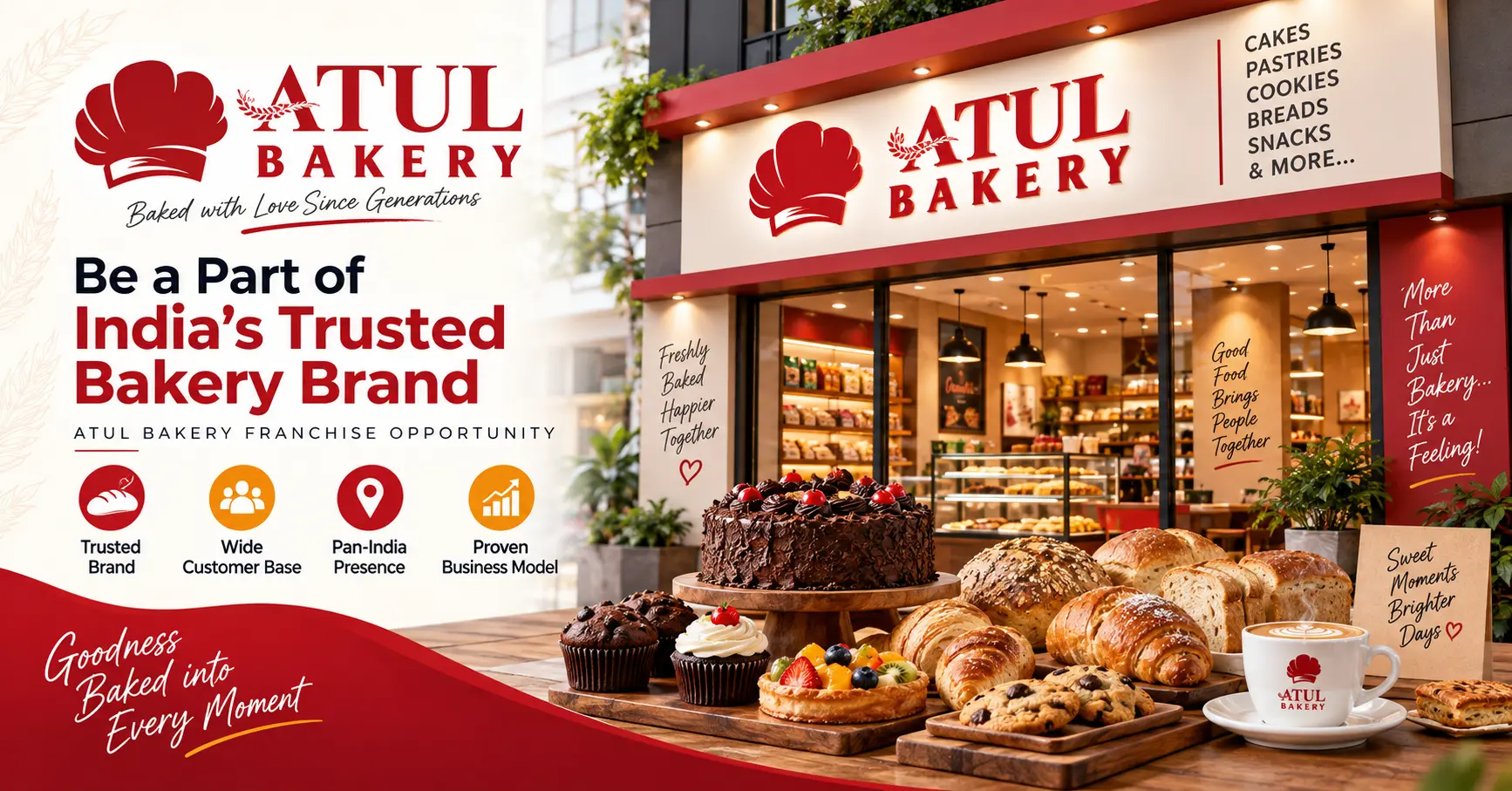
An Atul Bakery franchise appears refreshingly straightforward at first.
Unlike many food brands that make applicants submit an enquiry before revealing even a rough investment, Atul Bakery currently states the basic numbers openly.
The company says prospective franchisees should expect an initial investment of ₹15 lakh to ₹20 lakh and have access to approximately 700 to 2,500 sq. ft. of space.
That gives investors a useful starting point.
But it also creates a much bigger question.
A 700 sq. ft. bakery and a 2,500 sq. ft. bakery cannot possibly have identical property costs, interiors, staffing requirements and monthly rent.
So while ₹15–20 lakh is the number that attracts attention, the size and location of the outlet may ultimately have a greater impact on whether the franchise works financially.
And there are other numbers the official franchise page still doesn’t publish—including the current franchise fee, royalty structure, average sales, profit margin and payback period.
Here is what prospective Atul Bakery franchise owners should examine before investing.
Atul Bakery Has Grown Far Beyond Its Gujarat Roots
Atul Bakery says the business began in 2007, founded by Atul Vekariya with the idea of building a bakery around fresh baked products and customer celebrations.
The company’s current website says the network has expanded to 300+ outlets across three countries and offers more than 1,000 product varieties. It also claims more than one million cakes sold worldwide.
Its current Indian footprint remains particularly strong in Gujarat, while the company also says it is expanding toward markets including Maharashtra, Madhya Pradesh and Rajasthan and pursuing further international expansion.
The scale is important for prospective franchisees.
You’re not joining a bakery brand experimenting with its first few franchise outlets.
Atul Bakery says franchising has played a significant role in its expansion and that its operating model includes training, supply-chain systems, marketing and continuing operational assistance.
But a large network doesn’t automatically make every new outlet profitable.
The economics still need to work locally.
Atul Bakery Franchise Cost: The Official Figure Is ₹15–20 Lakh
Atul Bakery’s current franchise page states:
| Franchise Requirement | Current Official Information |
|---|---|
| Initial Investment | ₹15–20 lakh |
| Space Required | 700–2,500 sq. ft. |
| Training | Provided |
| Location & Store Setup Assistance | Provided |
| Supply-Chain Support | Provided |
| Marketing Support | Provided |
| Operational Guidance | Provided |
This makes Atul Bakery more transparent than several franchise opportunities where even a broad investment range is unavailable publicly.
However, there is one detail applicants should not miss.
₹15–20 lakh is an “initial investment”
The public page does not provide a detailed cost breakup showing exactly what is included in that figure.
For example, it does not publicly specify whether the ₹15–20 lakh estimate includes:
- Franchise fee
- Rental security deposit
- Advance rent
- Complete interiors
- Bakery equipment
- Display counters
- Refrigeration
- POS systems
- Signage
- Opening inventory
- Licences
- GST
- Launch marketing
- Working capital
That means an applicant should not automatically assume ₹20 lakh is the maximum cash required from beginning to opening and beyond.
Get the detailed project estimate first.
The 700–2,500 Sq. Ft. Range Could Matter More Than the Franchise Fee
This is perhaps the most interesting part of Atul Bakery’s current franchise proposition.
The company states a space requirement ranging from 700 sq. ft. all the way to 2,500 sq. ft.
That’s a difference of 1,800 sq. ft.
And that difference can radically change the business economics.
Imagine two franchisees.
Franchisee A: 700 sq. ft. outlet
This operator may potentially face:
- Lower monthly rent
- Smaller rental security deposit
- Lower interior cost
- Fewer display fixtures
- Smaller electricity bill
- Lower staffing requirement
Franchisee B: 2,500 sq. ft. outlet
A much larger format could involve:
- Premium property costs
- Larger interiors
- More customer seating
- Larger display areas
- Higher air-conditioning load
- Additional staffing
- Greater maintenance expenditure
The larger outlet could also generate considerably more revenue.
But it needs to.
A bigger bakery is only a better investment when the additional sales comfortably exceed the additional cost.
What applicants often overlook
“Investment required” and “capital employed” can become very different numbers once the property enters the calculation.
Suppose two locations both qualify for the franchise.
One costs ₹50,000 per month.
The other costs ₹1.5 lakh per month.
That’s a difference of ₹12 lakh in rent every year—before considering the larger deposit, utilities or staffing.
Over a five-year agreement, the difference becomes significant.
That’s why your financial model should begin with the proposed property rather than stop at the ₹15–20 lakh headline figure.
Why You May See Different Atul Bakery Franchise Numbers Online
Searching online can make the opportunity surprisingly confusing.
Atul Bakery’s current official franchise page says:
₹15–20 lakh investment
and
700–2,500 sq. ft. space.
But a current Franchise India listing claims:
- ₹10–20 lakh investment
- ₹3 lakh brand fee
- 200–300 sq. ft. area
- 25% royalty/commission
- 30% anticipated ROI
- 1–2 year payback
Those figures clearly don’t align with the official site’s current 700–2,500 sq. ft. space requirement.
That doesn’t necessarily mean every third-party number is wrong. Listings can be based on older terms, different formats or data supplied at another point in time.
But the discrepancy demonstrates exactly why franchise research should prioritize the brand’s latest written proposal and agreement.
Don’t calculate your return using the ₹3 lakh fee or 25% figure simply because a directory displays it.
Ask Atul Bakery directly whether those terms currently apply to the format being offered to you.
What Does the ₹15–20 Lakh Actually Need to Cover?
Before evaluating profitability, request a detailed cost sheet.
A good franchise investment breakup should make each of these areas clear:
| Cost Category | What You Need to Know |
|---|---|
| Franchise Fee | Current one-time amount |
| GST | Whether additional |
| Interiors | Included budget and specification |
| Display Counters | Who supplies them |
| Refrigeration | Included or additional |
| Bakery Equipment | Required machinery and ownership |
| Furniture | Depends on outlet format |
| Signage | Included or separately charged |
| POS/Software | Setup and recurring fee |
| Opening Inventory | Initial stock requirement |
| Property Deposit | Usually location-dependent |
| Advance Rent | If applicable |
| Training | Included or additional expenses |
| Launch Marketing | Who pays |
| Licences | Franchisee responsibility |
| Working Capital | Recommended reserve |
You should be able to answer one question before signing:
“What is the maximum realistic cash outflow between signing the franchise agreement and completing the first three to six months of operations?”
That’s far more useful than the franchise fee alone.
Atul Bakery Isn’t Just a Cake Shop
One advantage of the business is product diversification.
The brand’s current product portfolio includes categories such as:
- Cakes
- Pastries
- Sweets and chocolates
- Gift packs
- Namkeen
- Khari
- Breads
- Cookies and biscuits
- Savouries
Its current site lists dozens of products across these categories and describes the business as a one-stop bakery destination rather than simply a celebration-cake seller.
This matters financially.
A bakery dependent only on birthday cakes may experience demand concentrated around celebrations.
A broader portfolio can create different customer occasions:
Morning: bread and baked staples
Afternoon: snacks and savouries
Evening: pastries and impulse purchases
Celebrations: cakes
Festivals and gifting: gift packs, sweets and cookies
That diversity could improve customer frequency and average sales.
But it also makes inventory management more important.
1,000+ Varieties Sound Impressive—but Inventory Can Become Complicated
Atul Bakery’s website says the wider brand portfolio includes 1,000+ varieties of products.
No individual outlet necessarily needs to carry every product.
But a broad bakery assortment still creates several operational questions.
A franchisee should understand:
- Which items arrive ready to sell?
- Which are finished in-store?
- Which need refrigeration?
- What is the shelf life?
- Who bears expired-product losses?
- Can unsold products be returned?
- Which products must be stocked?
- How frequently does supply arrive?
- Is there a minimum order quantity?
These details can have a direct effect on profitability.
Unlike products with long shelf lives, fresh bakery items can lose their sale value quickly.
An outlet can have healthy gross margins on paper and still suffer if wastage is poorly controlled.
Atul Bakery’s Supply Chain Could Be One of Its Biggest Franchise Advantages
Atul Bakery specifically lists supply-chain support as part of its franchise offering. Its official support material says franchise outlets benefit from a structured supply system through which ready-to-sell products and ingredients can be supplied from the brand to help maintain consistency.
For a bakery franchise, this is particularly important.
An independent bakery may need to individually source:
- Flour
- Chocolate
- Cream
- Packaging
- Cake decorations
- Snack ingredients
- Bread inputs
- Cookies
- Frozen products
- Specialty ingredients
Centralized sourcing can simplify those relationships and help maintain standard products across outlets.
But franchisees should still ask about the commercial side.
Questions to ask about sourcing
Who sets purchase prices?
Are all products mandatory purchases?
Is freight included?
What delivery frequency can you expect?
Are minimum orders imposed?
Who bears damaged stock?
Who bears expiry and wastage?
Can prices change during the agreement?
Those answers affect the store’s gross margin.
What Support Does Atul Bakery Provide?
This is one area where Atul Bakery provides relatively clear information.
The official franchise page lists support in five major areas.
Initial Training
Atul Bakery says franchisees receive training covering the brand, products and operations.
The company’s separate franchise-support material also mentions guidance relating to product handling, customer service and structured operational processes.
Store Setup
The brand says it assists with:
- Location selection
- Store design
- Setup
This support is valuable, particularly because the official space requirement covers such a wide range.
Supply Chain
Atul Bakery says it has an established system for getting required products and ingredients to franchise partners.
Marketing and Promotions
The company says ongoing marketing support is offered to build visibility and drive sales. Its franchise-support page also references brand-level promotions and social-media activity.
Operational Guidance
Franchisees are promised regular updates, best practices and continuing operating support.
This support infrastructure is one of the clearest reasons to consider franchising rather than opening an independent bakery.
But it doesn’t eliminate normal retail risk.
What Is the Atul Bakery Franchise Profit Margin?
This is where the public information becomes much thinner.
Atul Bakery’s current official franchise page does not publish a guaranteed gross margin, monthly net profit, average outlet revenue or payback period.
That means any precise claim such as:
“Earn ₹2 lakh every month”
or
“Recover your investment in 18 months”
should be treated cautiously unless supported by the commercial proposal supplied directly by Atul Bakery.
Actual profitability can be simplified as:
Sales – Product Cost – Wastage – Salaries – Rent – Royalty – Electricity – Marketing – Delivery Costs – Maintenance – Other Expenses = Operating Profit
The actual percentage remaining will differ between outlets.
A Bakery Can Have Good Margins and Still Produce Poor Returns
This sounds contradictory, but it isn’t.
Imagine an outlet generates ₹12 lakh monthly revenue and has attractive product-level gross margins.
Now subtract:
- ₹1.25 lakh rent
- Employee salaries
- Electricity and refrigeration
- Wastage
- Royalty, if applicable
- Local marketing
- Delivery commissions
- Repairs and maintenance
The final number can look very different from the gross margin.
Now imagine another Atul Bakery store generating only ₹9 lakh in sales but paying much lower rent with efficient staffing and limited wastage.
The second outlet could potentially produce a stronger return.
This is why sales should never be evaluated without occupancy and operating costs.
Don’t Sign a Lease Until Atul Bakery Approves the Site
Because Atul Bakery promises assistance with location selection and store setup, applicants should make location approval part of the process before committing to an expensive commercial lease.
Before taking the property, ask the brand to confirm:
- Minimum carpet area
- Recommended frontage
- Ground-floor requirement
- Preferred catchment
- Electricity load
- Water requirements
- Refrigeration requirements
- Delivery access
- Parking requirements
- Signage visibility
- Kitchen or preparation area
- Storage requirement
A location can meet the square-footage requirement and still be commercially weak.
Which Location Could Work Best for Atul Bakery?
A bakery benefits from both planned purchases and impulse traffic.
Potentially attractive catchments can include:
- Dense residential areas
- High streets
- Shopping markets
- Near schools and colleges
- Office areas
- Premium residential developments
- Mixed-use neighbourhoods
- Locations with strong food-delivery demand
The key is repeat business.
Customers may buy birthday cakes only occasionally.
But bread, cookies, snacks, pastries and savouries can bring them back much more frequently.
When evaluating a site, estimate:
Daily customer count × average transaction value × 30 days
Then test whether that sales level can comfortably cover fixed costs.
Atul Bakery’s Expansion Plans Could Create Opportunities Beyond Gujarat
Atul Bakery’s current About page says it is targeting further Indian expansion into markets including Maharashtra, Madhya Pradesh and Rajasthan, while its wider ambitions include multiple overseas territories.
Its main website says the brand already has a particularly dense presence in Gujarat and also operates internationally.
For prospective franchisees outside the company’s strongest markets, expansion can create both an opportunity and a challenge.
The opportunity is entering before the market becomes crowded with the same brand.
The challenge is lower local brand recognition compared with territories where customers already know Atul Bakery.
Applicants should therefore ask whether the sales assumptions provided by the franchisor are based on outlets in:
- Gujarat
- Their own state
- Mature locations
- Newly entered markets
Those are not directly comparable.
How to Apply for an Atul Bakery Franchise
Atul Bakery lays out a six-step franchise process on its official website:
Application: Submit your details through the official franchise form.
Review: The franchise team evaluates the application.
Meeting: The opportunity and commercial details are discussed.
Agreement: The franchise agreement is signed.
Setup and Training: Atul Bakery assists with outlet development and training.
Launch: The new bakery begins operations.
The official application asks for basic information such as:
- Name
- Address
- Preferred city
- State
- Postal code
- Phone number
- Email address
Atul Bakery’s official Contact page currently lists:
Franchise Enquiry: +91 90990 55734
Head Office: Bhatpore GIDC, Ichhapore, Surat, Gujarat.
Using the brand’s official form and contact number is preferable to paying an unofficial franchise consultant.
The 18 Questions to Ask Before Investing
Atul Bakery already publishes its headline investment and space requirement.
Your job is to fill in the missing numbers.
Before signing, ask:
- Is ₹15–20 lakh the complete setup cost or only an initial estimate?
- What is the current franchise fee?
- Is GST additional?
- What current royalty applies?
- Is there a marketing contribution?
- Why does the space requirement range from 700 to 2,500 sq. ft.?
- Which outlet size is recommended for my city?
- Is property deposit excluded from the ₹15–20 lakh?
- How much working capital should I keep?
- What are typical product margins by category?
- What wastage percentage should an efficient store target?
- Who bears unsold or expired inventory?
- What supplies are compulsory purchases?
- How many employees are usually required?
- What sales level is needed to break even?
- What is the franchise-agreement duration?
- What renewal or transfer charges apply?
- Will I receive territorial exclusivity?
And if a representative gives you ROI figures, ask one more:
“Can you show me how that return is calculated?”
The answer should include the assumptions behind sales, rent, manpower, gross margin and total capital.
Is an Atul Bakery Franchise Worth Considering?
There are several reasons the opportunity deserves attention.
Atul Bakery has operated since 2007 and now claims more than 300 outlets globally. It offers a broad portfolio rather than relying only on cakes, and its current franchise page gives applicants a relatively clear starting investment of ₹15–20 lakh.
Franchisees are also offered:
- Training
- Location assistance
- Store-design assistance
- Supply-chain support
- Marketing
- Operational guidance
But several important commercial numbers are missing from the public franchise page.
These include:
- Exact franchise fee
- Royalty
- Average outlet turnover
- Product margin
- Net-profit margin
- Payback period
- Recommended working capital
That information needs to come from the current franchise proposal.
Frequently Asked Questions
What is the Atul Bakery franchise cost?
Atul Bakery currently states an initial investment of ₹15 lakh to ₹20 lakh on its official franchise page. Applicants should confirm exactly what is included and whether property deposits, working capital, GST and other expenses are additional.
How much space does an Atul Bakery franchise require?
The current official requirement is approximately 700 to 2,500 sq. ft. The large range suggests the exact space requirement may depend on outlet size or location, so applicants should get a site-specific recommendation before taking a property.
What is the Atul Bakery franchise profit margin?
Atul Bakery’s current franchise page does not publish a guaranteed profit margin or franchisee income figure. Actual profitability will depend on product margins, rent, staffing, wastage, franchise charges and sales.
What is the Atul Bakery franchise fee?
The current official franchise page does not publicly list a separate franchise fee. Third-party sources quote different numbers, so the current fee should be confirmed directly with Atul Bakery.
Does Atul Bakery charge royalty?
The official current franchise page does not publicly state a royalty percentage. Some third-party listings contain royalty figures, but applicants should not assume those reflect the current agreement. Verify the latest recurring charges directly with Atul Bakery.
Does Atul Bakery provide franchise training?
Yes. Atul Bakery says franchisees receive extensive initial training covering the brand, products and operations, along with continuing operational guidance.
Does Atul Bakery help select a location?
Yes. Location selection and store-setup assistance are listed among the support offered to franchise partners.
Does Atul Bakery provide products to franchisees?
The company says franchise partners benefit from its established supply chain. Its franchise-support material states that ready-to-sell products and ingredients are supplied through the brand’s system to support consistency.
How many Atul Bakery outlets are there?
Atul Bakery’s current website says the brand has 300+ outlets across the globe and operates across three or more countries.
When was Atul Bakery started?
The company says Atul Bakery was founded in 2007 by Atul Vekariya.
How do I apply for an Atul Bakery franchise?
Applications can be submitted through the official Atul Bakery franchise form. The company’s current franchise-enquiry number is +91 90990 55734.
The Bottom Line
The Atul Bakery franchise is unusual among many food-franchise opportunities because applicants don’t have to hunt around simply to discover the basic investment figure.
The company itself says:
₹15–20 lakh initial investment.
700–2,500 sq. ft. space.
But those two numbers shouldn’t be viewed independently.
A 700 sq. ft. bakery paying sensible neighbourhood rent and a 2,500 sq. ft. flagship-style outlet in a premium commercial location may carry the same brand name but have completely different financial profiles.
That is what prospective franchisees should focus on.
Atul Bakery can provide the brand, training, supply chain, marketing support and operating framework.
The applicant still needs to make sure the individual store economics work.
Before signing, get the complete ₹15–20 lakh cost breakup.
Confirm the current franchise fee and royalty.
Determine how much working capital sits outside the setup budget.
Understand wastage and product margins.
And most importantly, calculate whether the proposed property can generate enough sales to justify its rent and total capital requirement.
The ₹15–20 lakh franchise figure gets you interested. The 700–2,500 sq. ft. decision may determine what happens to your return.
Disclaimer: Franchise investment, fees, space specifications, support and commercial terms can change. The ₹15–20 lakh investment and 700–2,500 sq. ft. space requirement in this article are based on Atul Bakery’s current official franchise page. Other figures shown by third-party franchise websites may reflect older or different terms and should not be treated as current official pricing. Prospective franchisees should obtain the latest written proposal and franchise agreement directly from Atul Bakery before making any financial commitment.