
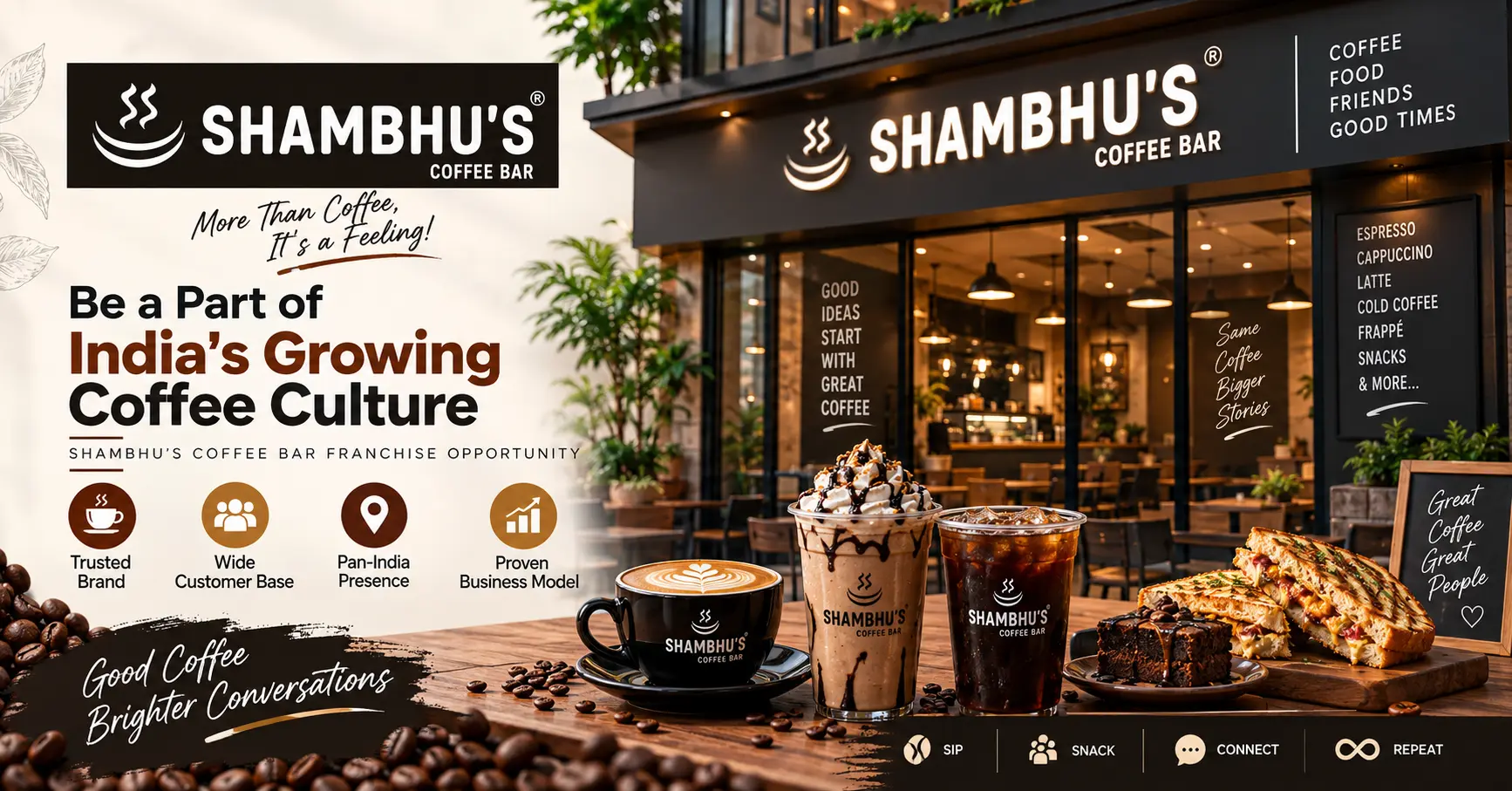
A Shambhu’s Coffee Bar franchise has a familiar entrepreneurial story behind it.
The brand traces its roots to Ahmedabad, where founder Shambhu Singh Chauhan started with a small roadside operation in 1998, initially building the business around affordable cold coffee and milkshakes. An Economic Times profile reported that the venture began with around ₹5,000 and gradually evolved from a street-side concept into a multi-outlet café business.
Today, Shambhu’s Coffee Bar operates across different parts of Gujarat, while its current outlet directory also identifies franchise locations and Canadian outlets.
That growth makes the franchise opportunity interesting.
But visit the company’s current official franchise page expecting a straightforward investment figure and you’ll notice something important.
Shambhu’s says it has developed a supply-chain system for franchisees, investors and entrepreneurs and talks about helping partners convert suitable properties into coffee lounges.
What it doesn’t publicly disclose is:
- Total franchise investment
- Franchise fee
- Royalty percentage
- Minimum area
- Average outlet sales
- Profit margin
- Working-capital requirement
- Break-even period
Third-party franchise websites do publish figures—often around ₹12–20 lakh.
But those figures are not confirmed on Shambhu’s current official franchise page.
That makes the most important question less about what one online portal says the franchise costs and more about:
What will Shambhu’s quote for your specific property, city and café format today?
Shambhu’s Coffee Bar Started With a Very Different Café Proposition
Shambhu’s built its identity around an accessible coffee experience rather than trying to copy premium international coffee chains.
The company’s own website emphasizes coffee, cold coffee, chocolate drinks, milkshakes, mocktails and quick bites. Its menu offering also extends into items such as garlic bread, club sandwiches, French fries, pizzas and desserts.
That wider menu matters for franchise economics.
Customers aren’t restricted to ordering one cup of coffee.
A typical transaction can potentially combine:
Coffee + snack
or
Shake + pizza
or
Cold coffee + sandwich
Higher average bills can be important because café businesses still need to cover rent, labour and utility expenses even when individual beverage prices remain relatively affordable.
Shambhu’s Coffee Bar Franchise Cost: The Official Website Doesn’t Say
This is the first major point prospective investors should understand.
Shambhu’s current official franchise application does not publish an investment range.
The company asks interested entrepreneurs to submit details about:
- Proposed city or suburb
- Name
- Address
- State
- Pincode
- Phone number
- Email address
It then positions itself as a business partner with an established supply-chain system for specialised coffee outlets.
But no financial quotation appears alongside the form.
So where does the ₹12–20 lakh number come from?
A current third-party listing from FranchiseByte estimates the infrastructure investment for a Shambhu’s Coffee Bar outlet at approximately:
₹12 lakh to ₹20 lakh
The same listing suggests a footprint of approximately 800–2,000 sq. ft. and an indicative ROI period of two to three years.
Another franchise directory repeats a similar ₹12–20 lakh investment range and 800–2,000 sq. ft. area.
Those figures can help investors understand the possible scale of the opportunity.
But they should not be presented as Shambhu’s current official franchise quotation.
The company’s own live franchise page currently confirms none of those numbers.
Treat them as third-party estimates until Shambhu’s confirms them in writing.
The ₹12–20 Lakh Estimate May Not Be the Full Amount You Need
Even if Shambhu’s quotes an investment somewhere within that range, the first question should be:
What exactly is included?
A café project can involve much more than the franchise licence.
Potential expenses include:
| Cost Area | What You Need to Confirm |
|---|---|
| Franchise Fee | Current one-time brand fee |
| Property Deposit | Usually separate and location-dependent |
| Advance Rent | May start before opening |
| Interiors | Brand-standard design and execution |
| Furniture | Tables, chairs, counters and décor |
| Coffee Equipment | Machines, grinders and preparation tools |
| Refrigeration | Cold beverages and food storage |
| Kitchen Equipment | Equipment needed for snacks and meals |
| Air Conditioning | Equipment and installation |
| Signage | Exterior and interior branding |
| POS System | Setup and recurring software fees |
| Initial Inventory | Coffee, milk, food and packaging |
| Licences | FSSAI and applicable local permissions |
| Staff Training | Confirm what is included |
| Launch Marketing | Local-opening promotion |
| Working Capital | Money required after opening |
This is where applicants can underestimate the real capital requirement.
A ₹15 lakh café setup can potentially require significantly more available capital once a large commercial property deposit and several months of operating expenses are added.
Why Working Capital Deserves Its Own Budget
A new café does not normally reach stable sales the morning it opens.
During the early months, the owner may still need to pay:
- Rent
- Salaries
- Electricity
- Milk and food purchases
- Packaging
- Maintenance
- Delivery commissions
- Marketing
- Franchise charges
regardless of whether sales are meeting projections.
That is why franchise investment should really be thought about as:
Outlet Setup + Property Costs + Working Capital
Not simply:
Franchise Fee + Interiors
Before investing, ask Shambhu’s:
“How much working capital do you recommend keeping after the café opens?”
The Space Requirement Is Another Number That Needs Verification
Third-party listings commonly quote 800–2,000 sq. ft. for a Shambhu’s Coffee Bar franchise.
But again, the official franchise page does not currently publish a universal area requirement.
That distinction matters because an 800 sq. ft. café and a 2,000 sq. ft. café have completely different economics.
An 800 sq. ft. café could mean:
- Lower rent
- Lower property deposit
- Smaller interiors budget
- Fewer seats
- Fewer employees
- Lower electricity expenditure
A 2,000 sq. ft. coffee lounge could mean:
- Higher rent
- Larger seating capacity
- More elaborate interiors
- More air conditioning
- Additional employees
- Greater maintenance cost
The larger café needs to generate enough extra sales to justify those additional costs.
A visually impressive outlet is not automatically a financially stronger outlet.
Shambhu’s Existing Outlets Show That the Brand Uses Different Location Types
The current official store locator includes cafés across Ahmedabad and other Gujarat markets in settings ranging from high streets and highways to university areas and riverfront locations. It also identifies several locations specifically as franchise outlets.
Examples of locations on the official directory include areas around:
- H.L. College Road
- Prahlad Nagar
- Nirma University
- Ahmedabad Airport
- Sabarmati Riverfront
- S.G. Highway
- Satellite
- South Bopal
- Himmatnagar
- Navsari
- Jamnagar
- Gandhinagar
The directory also lists Canadian franchise locations.
That suggests Shambhu’s concept can operate in several catchment types.
But different locations need different sales expectations.
A College Café and Highway Café Shouldn’t Use the Same Business Plan
Consider two potential Shambhu’s locations.
Near a college
Potential advantages:
- Frequent young customers
- Repeat visits
- Strong demand for cold coffee and snacks
- Evening traffic
- Word-of-mouth potential
Potential disadvantages:
- Price-sensitive customers
- Seasonal college schedules
- Limited parking
- Lower average transaction size
Highway location
Potential advantages:
- Larger property availability
- Parking
- Family and group customers
- Higher potential average order value
Potential disadvantages:
- More dependence on passing traffic
- Higher staffing requirements
- Larger premises
- Potentially less repeat frequency
Both locations can work.
But their unit economics can be completely different.
This is why projected sales should be calculated for your site, not copied from another franchisee.
Shambhu’s Positioning Has Historically Been About Value and Volume
The Economic Times reported that Shambhu’s differentiated itself from larger branded coffee chains partly through affordable pricing and flavours adapted to Indian preferences.
At the time of that profile, the company described its target audience as students, middle-class consumers and office-goers, with value and transaction volume forming an important part of its business model.
Although that report is historical and today’s economics will differ, the underlying concept remains relevant.
A value-focused café needs sufficient transaction volume.
That creates a simple relationship:
Customers per day × Average bill = Daily sales
If your average bill is relatively affordable, customer traffic becomes particularly important.
Coffee Isn’t the Only Thing Generating Revenue
One mistake investors can make is evaluating Shambhu’s purely as a coffee business.
Its current official website describes a much broader selection.
Alongside hot and cold coffee, it highlights:
- Dry-fruit shakes
- Milkshakes
- Mocktails
- Slushes
- Soft beverages
- Garlic bread
- Club sandwiches
- French fries
- Pizza
- Brownies
That menu breadth can potentially help increase the average bill.
But it also creates additional costs.
Every additional category can introduce:
- More ingredients
- More refrigeration
- Additional preparation equipment
- Increased wastage risk
- Additional training
- More complex inventory
So franchisees should ask:
Which menu categories generate the majority of outlet sales?
and
Which categories generate the strongest contribution margin?
Those answers are more useful than simply knowing how many items appear on the menu.
Shambhu’s Says Supply-Chain Support Is a Major Part of the Franchise
This is one of the clearest benefits stated on the official franchise page.
Shambhu’s says it has developed a smooth supply-chain management system specifically geared toward specialised coffee outlets and makes that system available to franchisees and entrepreneurs.
That can be a meaningful advantage.
A new independent café has to establish suppliers for:
- Coffee
- Milk
- Chocolate
- Flavours and syrups
- Food ingredients
- Packaging
- Disposable products
- Cleaning supplies
A franchised system can simplify some of those relationships and help maintain consistency.
But the commercial terms still matter.
Ask these supply-chain questions
Which products must be purchased from Shambhu’s?
Which can be sourced locally?
Are approved vendors compulsory?
What are the minimum order quantities?
Who pays freight?
How frequently are deliveries made?
Are purchase prices fixed or variable?
Who bears expired stock?
Can products be returned?
Supply-chain support is useful only when you also understand its impact on gross margin.
Training Appears to Be Part of the Brand’s Operating Philosophy
Shambhu’s official website says its baristas and servers undergo training and development as part of maintaining the café experience. It also states that its professionally developed café concept is made available to prospective partners.
That suggests standardisation is an important component of the franchise system.
Still, a prospective franchisee should ask exactly what training the current agreement includes.
For example:
- Franchise-owner training
- Barista training
- Kitchen training
- Customer-service training
- POS training
- Inventory management
- Hygiene standards
- Opening support
- Refresher training
Also ask whether employee travel and accommodation costs during training are included or borne by the franchisee.
What Is the Shambhu’s Coffee Bar Franchise Royalty?
The official franchise page currently does not publish a royalty percentage.
Third-party sources suggest the brand may retain roughly 5%–7% of revenue under some franchise structures.
That should be treated as unverified until confirmed by Shambhu’s.
Applicants should ask:
- Is there a royalty?
- What percentage?
- Is it calculated on gross sales?
- Is GST additional?
- Is there a minimum monthly payment?
- Is marketing charged separately?
- Are software fees additional?
- Are supply-chain margins separate?
A difference of only a few percentage points can become substantial across a full year of café sales.
Why Revenue-Based Fees Need Extra Attention
Suppose an outlet generates ₹15 lakh in monthly sales.
If a franchise fee is based on gross sales, the fee is generally calculated from that ₹15 lakh regardless of whether your rent is unusually high or whether delivery-platform commissions have reduced margins.
That’s why café profitability needs to be modelled after all franchise-related charges, not before them.
The formula is closer to:
Sales
– Food & Beverage Cost
– Staff
– Rent
– Royalty
– Utilities
– Delivery Commissions
– Marketing
– Maintenance
= Operating Profit
The final number matters far more than turnover.
What Is the Shambhu’s Coffee Bar Franchise Profit?
Shambhu’s official website currently does not publish a guaranteed monthly profit, profit margin or ROI period.
Third-party directories claim a break-even or ROI period of around 24–36 months, but this is not confirmed by the current official franchise page.
That difference should be made clear.
A third-party payback estimate is not a franchisor guarantee.
Actual returns depend on:
- Sales volume
- Average bill
- Food and beverage cost
- Rent
- Staffing
- Electricity
- Royalty
- Delivery mix
- Wastage
- Marketing
- Total capital invested
Before accepting any payback claim, ask to see the underlying assumptions.
A “2–3 Year ROI” Means Little Without the Calculation
Suppose a franchise costs ₹18 lakh to set up.
But then you add:
- ₹5 lakh rental deposit
- ₹2 lakh pre-opening costs
- ₹5 lakh working capital
Your actual capital employed has become ₹30 lakh.
If someone calculates the ROI only on the ₹18 lakh store setup figure, the result can look far more attractive than it really is.
So always calculate:
Annual Profit ÷ Total Capital Actually Invested
Not merely:
Annual Profit ÷ Advertised Franchise Cost
This is particularly important when comparing Shambhu’s with other coffee and tea franchises.
Delivery Can Increase Revenue but Reduce Contribution
Coffee, shakes, sandwiches and snacks naturally work with food-delivery platforms.
That creates another sales channel.
But aggregator orders can also involve:
- Platform commissions
- Discounts
- Advertising charges
- Packaging
- Promotional participation
An outlet generating ₹3 lakh of delivery-platform sales does not necessarily retain the same contribution as ₹3 lakh of direct dine-in sales.
Ask Shambhu’s for typical channel mix:
Dine-in vs takeaway vs online delivery
and model each channel separately if possible.
The Property Could Decide Whether the Franchise Works
Shambhu’s official franchise page specifically discusses entrepreneurs looking to convert properties into coffee lounges.
That wording makes location selection particularly important.
Before committing to a lease, confirm:
- Required carpet area
- Frontage
- Parking
- Outdoor seating rules
- Exhaust requirements
- Electrical load
- Water supply
- Signage rights
- Operating-hour restrictions
- Delivery access
- Neighbourhood noise restrictions
- AC requirement
- Kitchen requirement
And make approval from Shambhu’s a condition before locking yourself into an expensive property whenever possible.
How to Apply for a Shambhu’s Coffee Bar Franchise
Shambhu’s provides a dedicated franchise enquiry form on its official website.
Applicants are asked to identify the city or suburb where they intend to establish an outlet and provide basic contact and address information.
The site currently lists:
Email: info@shambhuscoffeebar.com
General phone: +91 84010 12333
One detail worth noting is that Shambhu’s official pages currently display different business-enquiry telephone numbers.
The franchise page lists:
+91 81558 89955
while the current Contact page lists:
+91 91060 58796, with business enquiry hours of 10 AM to 6 PM.
Because of that inconsistency, using the official franchise form and official email address alongside the current phone details may be the safest way to begin the enquiry.
The 20 Questions to Ask Before Investing
Since Shambhu’s doesn’t currently publish most financial terms publicly, applicants should use the franchise discussion to fill in every missing number.
Ask:
- What is the current total franchise investment?
- What is the upfront franchise fee?
- What is the current royalty?
- Is GST additional?
- Is there a separate marketing contribution?
- What minimum area is currently required?
- Is 800–2,000 sq. ft. still relevant?
- What is the recommended frontage?
- Does the investment include interiors?
- Does it include kitchen and coffee equipment?
- Is the rental deposit additional?
- What working capital is recommended?
- What is the typical employee count?
- What food and beverage cost should an efficient outlet target?
- What are mandatory supply-chain purchases?
- What percentage of business typically comes from delivery?
- What training is included?
- What is the agreement duration?
- What renewal or transfer fees apply?
- Is territorial protection offered?
If the company provides revenue or ROI projections, ask:
“Are these based on average mature outlets, selected successful stores or an estimate for my specific location?”
That is crucial.
Is a Shambhu’s Coffee Bar Franchise Worth Considering?
There are several reasons to investigate the opportunity.
Shambhu’s has been part of Ahmedabad’s café scene for decades, operates a menu extending beyond coffee into shakes and food, maintains an active network of company and franchise outlets, and explicitly says franchise partners can access its established supply-chain system.
The official website also shows that the brand has developed a recognisable café environment and places importance on trained staff and product consistency.
However, several crucial commercial numbers remain absent from the public franchise page.
These include:
- Current investment
- Franchise fee
- Royalty
- Store-area requirement
- Average sales
- Profit margin
- Working capital
- Break-even period
Without those numbers, you cannot properly compare Shambhu’s with another café franchise.
Frequently Asked Questions
What is the Shambhu’s Coffee Bar franchise cost?
Shambhu’s current official franchise page does not publish an investment figure. Third-party franchise directories currently estimate an infrastructure investment of around ₹12–20 lakh, but applicants should treat this as unverified until Shambhu’s provides a current written quotation.
How much space is required for a Shambhu’s Coffee Bar franchise?
The official franchise page does not currently specify a minimum area. Third-party listings suggest approximately 800–2,000 sq. ft., but the latest location requirement should be verified with the brand before taking a property.
What is the Shambhu’s Coffee Bar franchise fee?
The current official franchise page does not publicly disclose a separate franchise fee. Obtain the latest fee and GST treatment directly from Shambhu’s.
Does Shambhu’s Coffee Bar charge royalty?
The official website currently does not state a royalty percentage. Third-party listings suggest a brand share in the range of roughly 5%–7%, but this is not confirmed on Shambhu’s current franchise page and should not be used in a financial model without direct verification.
What is the Shambhu’s Coffee Bar franchise profit margin?
Shambhu’s does not currently publish a guaranteed profit margin on its official franchise page. Net profitability will depend on sales, product costs, rent, staffing, royalty, utilities, delivery commissions and other operating expenses.
How long does it take to recover the investment?
Some third-party sources suggest around two to three years, but Shambhu’s current official page does not publish or guarantee a payback period. Applicants should calculate returns using their complete project investment and location-specific expenses.
When did Shambhu’s Coffee Bar start?
A historical Economic Times profile reports that founder Shambhu Singh Chauhan began the business in Ahmedabad in 1998, initially starting with around ₹5,000.
What does Shambhu’s Coffee Bar sell?
The brand’s current site highlights hot and cold coffee, milkshakes, dry-fruit shakes, mocktails and other beverages alongside food such as sandwiches, garlic bread, fries, pizzas and brownies.
Does Shambhu’s provide supply-chain support?
Yes. Its current official franchise page specifically states that the brand has developed a supply-chain management system for specialised coffee outlets and makes it available to franchisees and entrepreneurs.
Does Shambhu’s have franchise outlets outside India?
Its current official outlet directory lists franchise locations in Canada in addition to its Indian network.
How can I apply for a Shambhu’s Coffee Bar franchise?
Use the official franchise enquiry form on Shambhu’s Coffee Bar’s website. The site also lists info@shambhuscoffeebar.com and current business-enquiry contact numbers.
The Bottom Line
The Shambhu’s Coffee Bar franchise has a compelling brand story—but its current franchise page requires investors to do more homework than the headline opportunity suggests.
The company clearly tells prospective franchisees one important thing:
You won’t be starting completely alone.
Shambhu’s says partners can tap into its established coffee-outlet supply chain and café concept.
But the most important financial numbers remain behind the enquiry process.
Third-party websites may suggest ₹12–20 lakh investment, 800–2,000 sq. ft. and a two-to-three-year payback, but none of those figures is currently confirmed on Shambhu’s official franchise page.
So don’t start with the assumption that ₹12 lakh is enough.
Start with the property.
Ask Shambhu’s what format fits the location.
Get the franchise fee, royalty, equipment cost, fit-out budget and supply-chain terms in writing.
Then add the rental deposit and working capital.
Finally, calculate how many customers the café needs every day to cover all of those expenses.
Shambhu’s may provide the coffee, brand system and operating support.
The real investment decision begins when you discover what the official franchise page currently leaves blank.
Disclaimer: Shambhu’s Coffee Bar’s current official franchise page does not publicly disclose the franchise investment, fee, royalty, space requirement or expected profitability. Third-party figures cited in this article are provided only as indicative context and should not be treated as current official commercial terms. Prospective franchisees should obtain a current written quotation and franchise agreement directly from Shambhu’s Coffee Bar before making any financial commitment.