

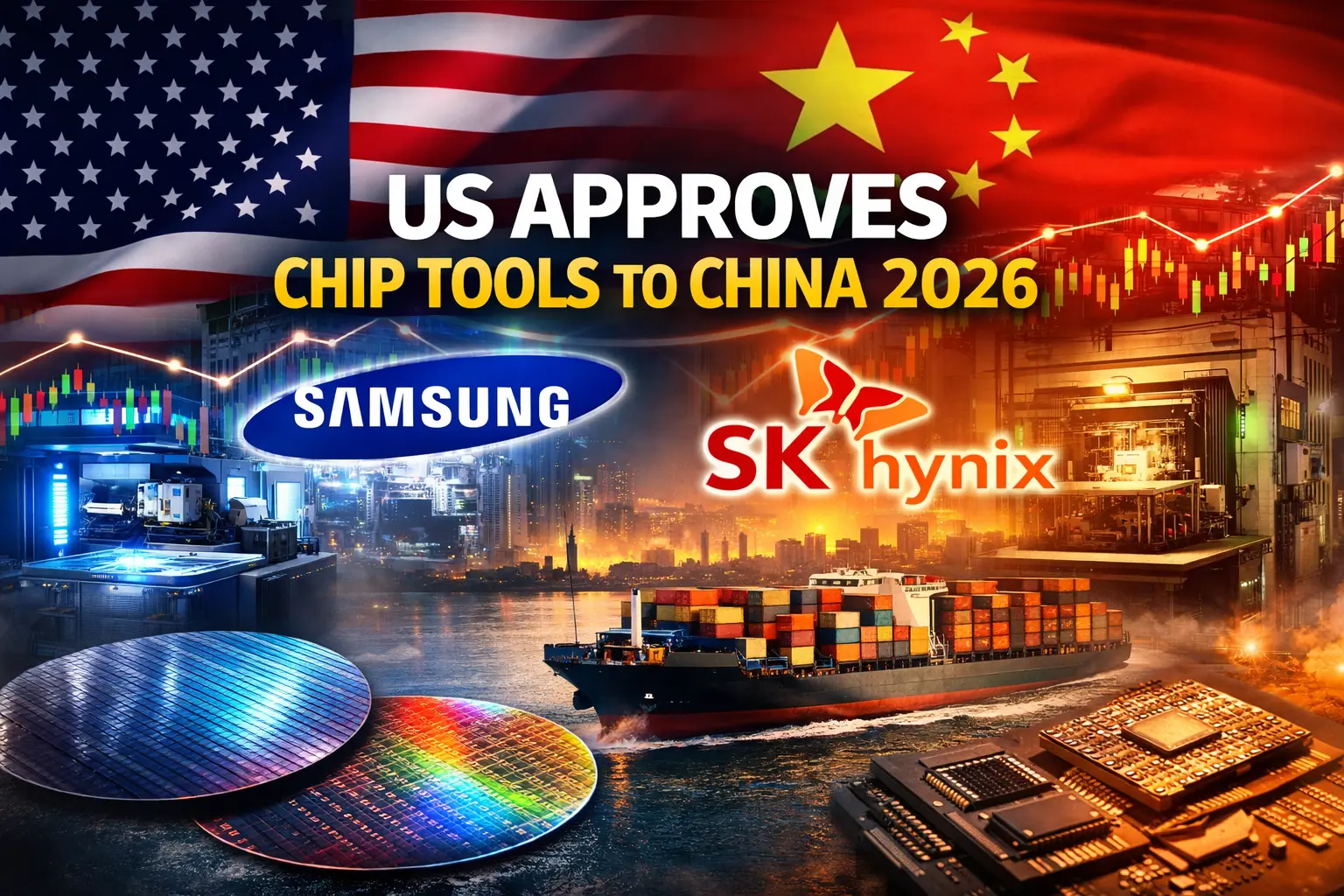
The approval by the US government allowing Samsung and SK Hynix to ship chipmaking tools to China in 2026 is being seen as a major and decisive move for the global semiconductor industry. This decision comes at a time when the worldwide chip supply chain has been under constant pressure due to geopolitical tensions and strict technology control policies. The approval signals a shift toward controlled cooperation aimed at maintaining stability in advanced manufacturing operations.
The impact of this decision is not limited to these two companies alone. It is expected to influence the global electronics market including smartphones memory chips automotive semiconductors and AI infrastructure. If you want to understand why this approval is important how it affects investors manufacturers and what it means for the semiconductor industry heading into 2026 this article provides a complete explanation.
Key Highlights and Major Takeaways
This approval clarifies several important points for policymakers and industry leaders. The US administration has chosen to allow operational flexibility while maintaining strategic controls to prevent instability in the global semiconductor market.
Key Highlights
Approval Year 2026
Approved Companies Samsung and SK Hynix
Destination China based semiconductor facilities
Scope of Tools Chipmaking equipment for maintenance and upgrades
Policy Direction Controlled cooperation with restrictions
Market Impact Improved supply stability and investor confidence
These highlights clearly show that the decision is intended to balance short term market relief with long term strategic control.
Background and Policy Context Behind the Approval
Technology access between the United States and China has remained a sensitive issue for several years. Export restrictions on advanced semiconductor tools were tightened to limit technological advancement in certain regions. As a result foreign operated fabrication plants in China faced challenges in maintenance and operational upgrades.
Against this backdrop the US decision to grant limited approval for 2026 aims to avoid severe supply disruptions while preserving national security interests. Samsung and SK Hynix facilities in China play a critical role in global memory chip supply and completely isolating them could have triggered widespread market instability.
Strategic Importance for Samsung and SK Hynix
For both Samsung and SK Hynix their manufacturing units in China are an essential part of their global production ecosystem. Demand for memory chips continues to rise across smartphones data centers automotive electronics and artificial intelligence applications.
This approval allows both companies to maintain operational efficiency improve production yield and avoid unexpected disruptions. It also supports capital expenditure optimization and strengthens their competitive position in the global semiconductor market over the long term.
Impact on the China Semiconductor Ecosystem
For the Chinese semiconductor ecosystem this approval ensures operational continuity in foreign invested fabrication plants. A slowdown in these facilities could have had a significant negative impact on the domestic electronics manufacturing sector.
The decision provides relief to local supply chain partners logistics providers and downstream manufacturers. While expansion into advanced chip nodes remains restricted maintenance and efficiency upgrades will help maintain consistent production output.
Signal for Global Markets and Investors
Global investors are viewing this approval as a signal of de escalation rather than complete decoupling. Semiconductor stocks have experienced volatility largely due to uncertainty surrounding international technology policies.
By allowing controlled approvals the US is indicating a preference for managed interdependence. This reduces policy risk improves long term planning and encourages continued investment in research and development across the semiconductor sector.
Future Outlook for 2026 and Beyond
The future policy direction beyond 2026 will depend on global geopolitical developments technological leadership priorities and market demand. However the current approval sets a precedent that compliant and transparent operations can receive limited permissions.
Companies are expected to continue diversifying manufacturing locations while maintaining a presence in China for scale and efficiency. This balanced strategy is likely to define the next phase of evolution in the global semiconductor industry.
Conclusion
The US decision to approve Samsung and SK Hynix chipmaking tool shipments to China for 2026 represents a pragmatic approach toward global semiconductor stability. It reflects an effort to balance security concerns with economic realities. In the coming years this approval is expected to strengthen supply chain resilience and restore confidence across the global technology market.
Frequently Asked Questions
Why did the US approve chipmaking tool shipments for 2026
The approval aims to maintain global supply chain stability while allowing controlled cooperation under strict policy oversight.
Is this approval permanent
No this is a limited and time bound approval with specific conditions.
How will Samsung and SK Hynix benefit
They will be able to maintain manufacturing continuity improve efficiency and strengthen market confidence.
What impact will this have on the China market
It supports production stability and helps sustain downstream electronics manufacturing.
What does this mean for global investors
It reduces policy uncertainty and increases confidence in the semiconductor sector.